
A no spend challenge is a set stretch of time, usually a weekend, a week or a whole month, where you only pay for your essentials and cut every extra purchase. January is the most popular time to try one: it resets your spending after the holidays, shows you exactly where your money leaks, and leaves you with a real number to move into savings or toward debt. Below are the rules that make it work, the free things to do instead of shopping, how it works with kids at home, and a free printable 31-day tracker.
This post contains affiliate links. If you buy through them I may earn a small commission at no extra cost to you. As an Amazon Associate I earn from qualifying purchases. Some photos are AI generated to show the idea.
- Pick your dates: a no spend weekend, 7 days, 21 days or a full month.
- Write two lists before you start: what you can still spend on, and what you won’t.
- Plan your meals from what’s already in the pantry and freezer.
- Delete shopping apps, unsubscribe from store emails and keep a 30-day wish list.
- Color in the tracker every no spend day, and decide now where the money you save is going.
Free printable no spend challenge tracker
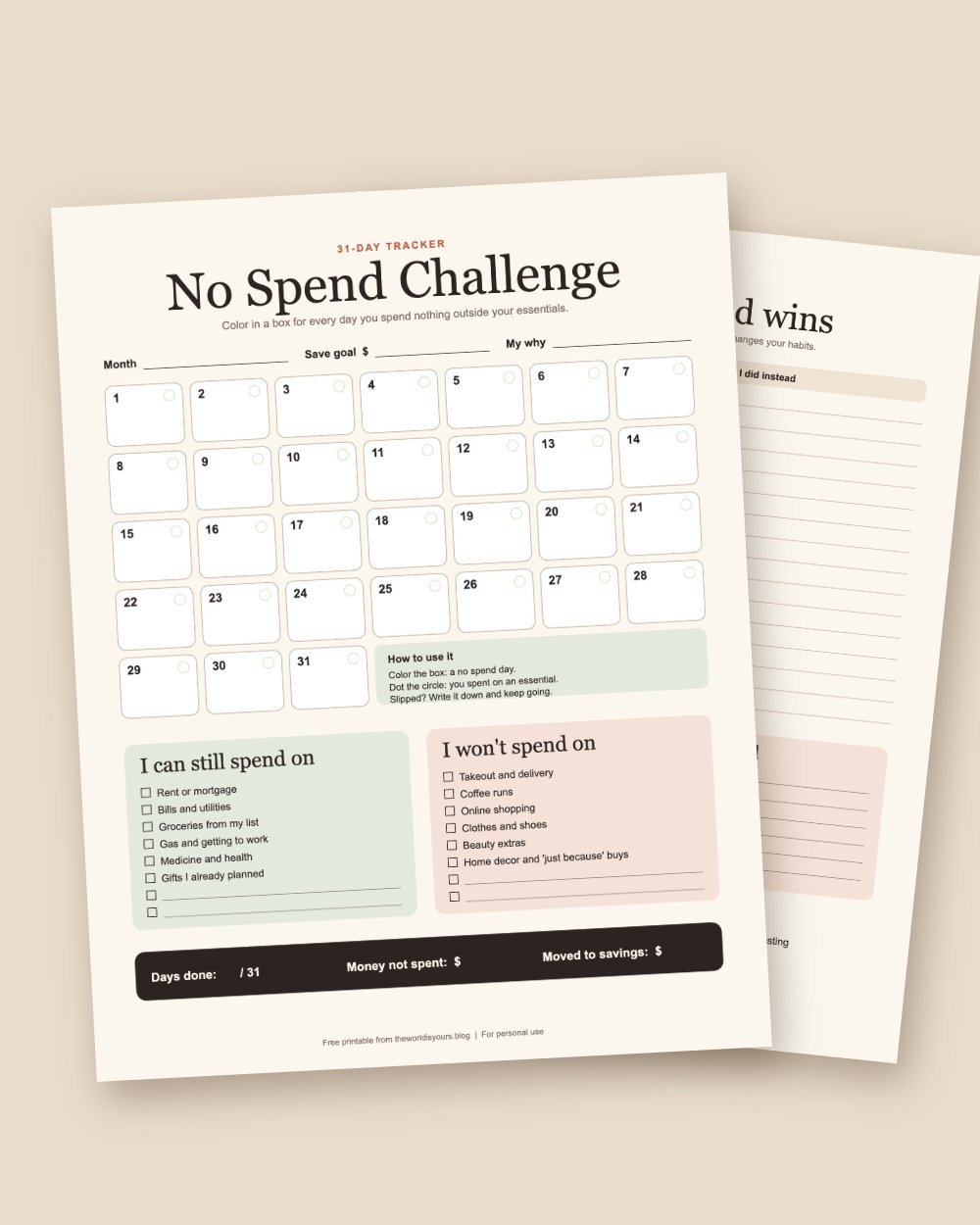
This is the tracker I’d stick on the fridge. Page one has a 31-day calendar to color in, a box for your goal and your why, and your can spend and won’t spend lists. Page two is an urges log: every time you want to buy something, write down what it was, what it would have cost and what you did instead. That page is where the habit change really happens. It comes in US Letter and A4, it’s free, and there’s no sign-up.
Set up your tracker on the fridge


What is a no spend challenge?
It’s a short, set period where you stop all spending that isn’t essential. You still pay rent, bills, groceries, gas and anything you need for your health. What goes is the extra stuff: takeout, coffee runs, online orders, the quick Target trip that turns into $60, new clothes, beauty top-ups and home decor.
It isn’t a budget, and it isn’t meant to last forever. Think of it as a reset. For a few days or weeks you break the autopilot, notice what you buy out of habit or boredom, and come out the other side with money saved and a much clearer idea of what you actually value.
Why January works so well
January is when everyone is looking at their bank balance after the holidays, and plenty of people are already doing one. A NerdWallet survey found that more than a quarter of Americans have tried a No Spend January at least once, and US Google searches for it reached an all-time high in January 2026 (Sherwood News). There’s also less to tempt you: the holiday sales are over, it’s cold, and staying in feels normal.
No spend challenge rules that actually work

The challenges that fall apart usually have fuzzy rules. Spend 20 minutes on these before day one and you’ll thank yourself in week two.
- Set your dates. Start and end dates on paper. A full month is the classic, but a weekend or a week is a great first try.
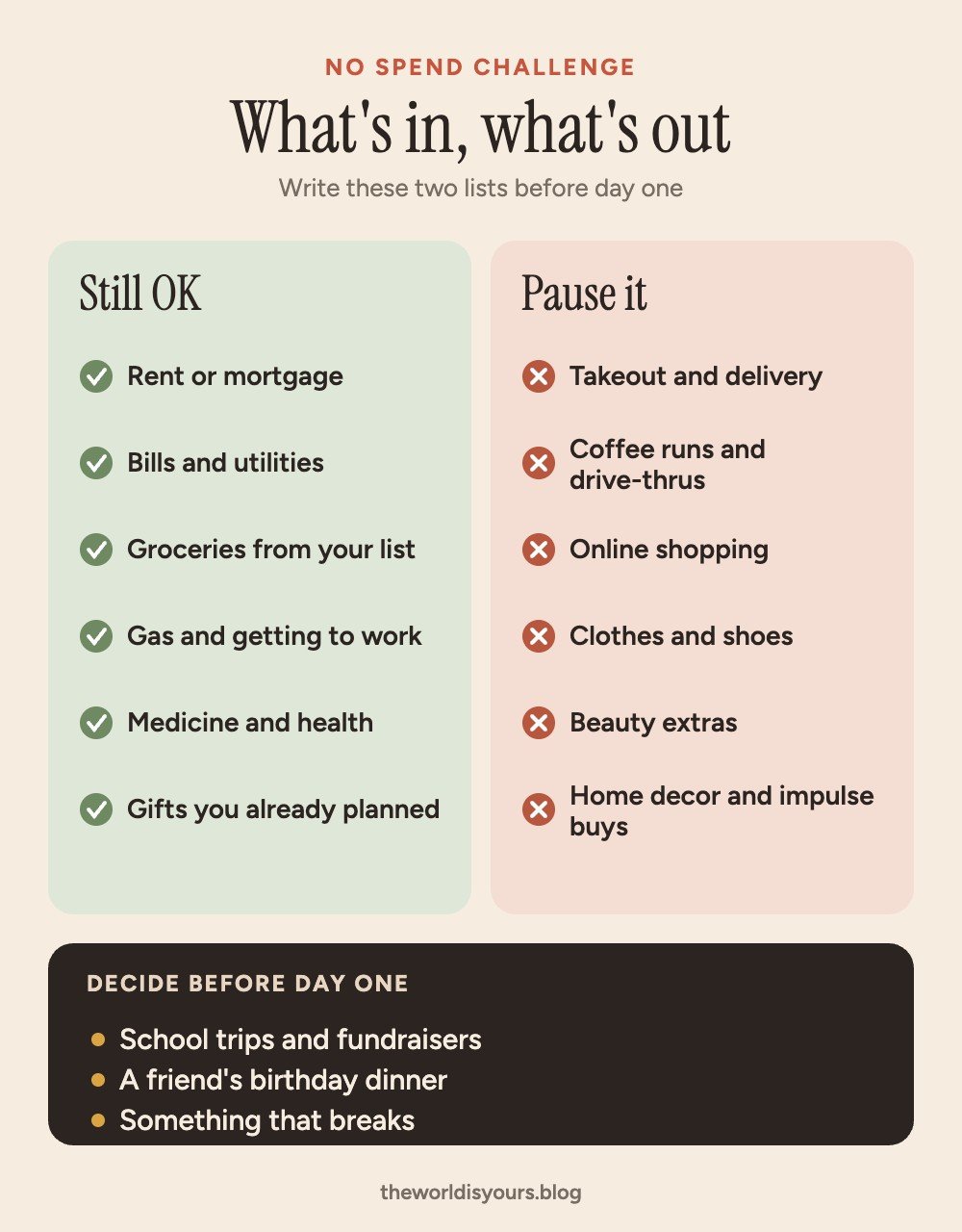
- List what you can still spend on. Rent or mortgage, bills, groceries from a list, gas or transit, medicine and anything already planned, like a birthday gift you’d promised.
- List what you won’t spend on. Be specific. “Shopping” is too vague; “clothes, shoes, home decor, takeout, coffee shops, online orders” is clear.
- Decide on the grey areas now. Kids’ school trips, a friend’s birthday dinner, replacing something that breaks. Decide before it happens, not in the moment.
- Plan your meals. Groceries are allowed, but they’re also where most challenges leak. Shop once a week from a list built around what you already have.
- Remove the easy buttons. Delete shopping and food delivery apps, log out of saved cards and unsubscribe from store emails for the month.
- Track it every day. Color in a box on the tracker each night. Seeing the streak build is half the motivation.
- Give the money a job. Pick where the savings go before you start: an emergency fund, a debt or a goal. A vague “save more” rarely sticks.
| Usually fine | Off limits | Decide in advance |
|---|---|---|
| Rent or mortgage, utilities, phone | Takeout and food delivery | Kids’ school trips and fundraisers |
| Groceries from your list | Coffee shops and drive-thrus | A friend’s birthday dinner |
| Gas, transit, parking for work | Online shopping and “just because” orders | Replacing something that breaks |
| Medicine and health | Clothes, shoes and beauty extras | Subscriptions you might cancel |
| Gifts you already planned | Home decor and new hobby gear | Travel already booked |
Pick your version
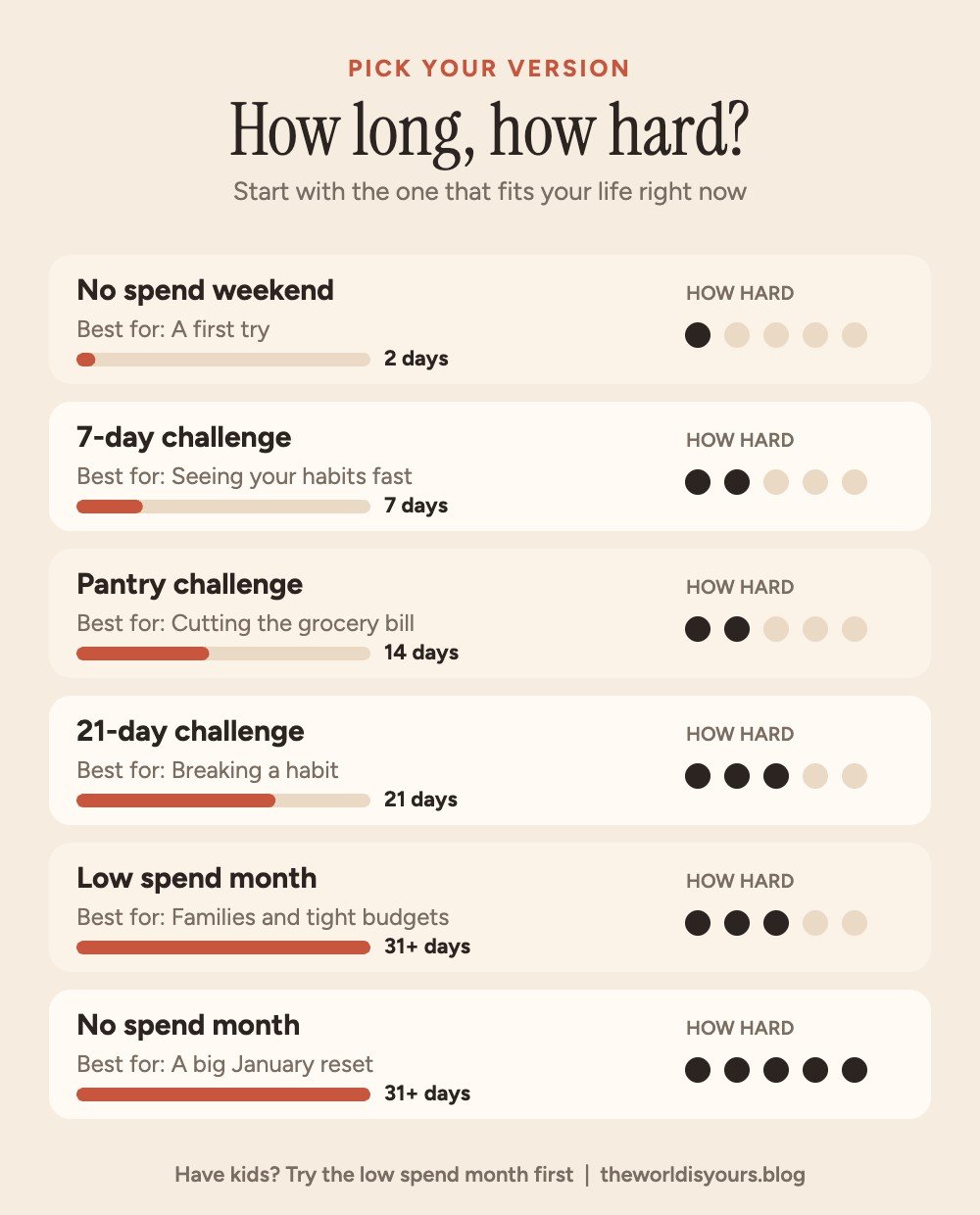
There’s no single right way to do this. Pick the one that fits your life right now, not the most extreme one you saw on Pinterest.
| Version | How it works | Best for |
|---|---|---|
| No spend weekend | Friday night to Sunday night, nothing extra | A first try, or a monthly reset |
| 7-day no spend challenge | One week, essentials only | Seeing your habits quickly |
| 21-day challenge | Three weeks, long enough to break a habit | People who want a real change but not a full month |
| No spend month | 30 or 31 days, the classic | January, or any month you want a big reset |
| Low spend month | Essentials plus one small weekly treat budget | Families, and anyone who’s tried and burned out before |
| Pantry challenge | No grocery shop beyond fresh basics until the cupboards are cleared | Cutting a big grocery bill |
If you have kids, I’d honestly start with a low spend month. A tiny weekly treat budget, even $10, stops the whole thing collapsing the first time someone needs poster board at 8pm.
How to do a no spend month, week by week
Get the pantry ready before day one


The week before
Write your lists, print the tracker, check the calendar for birthdays, school events and anything you’ll need to buy. Do one big grocery shop around a meal plan, top up the essentials you know will run out, and delete the apps. Tell the people you live with what you’re doing and why.

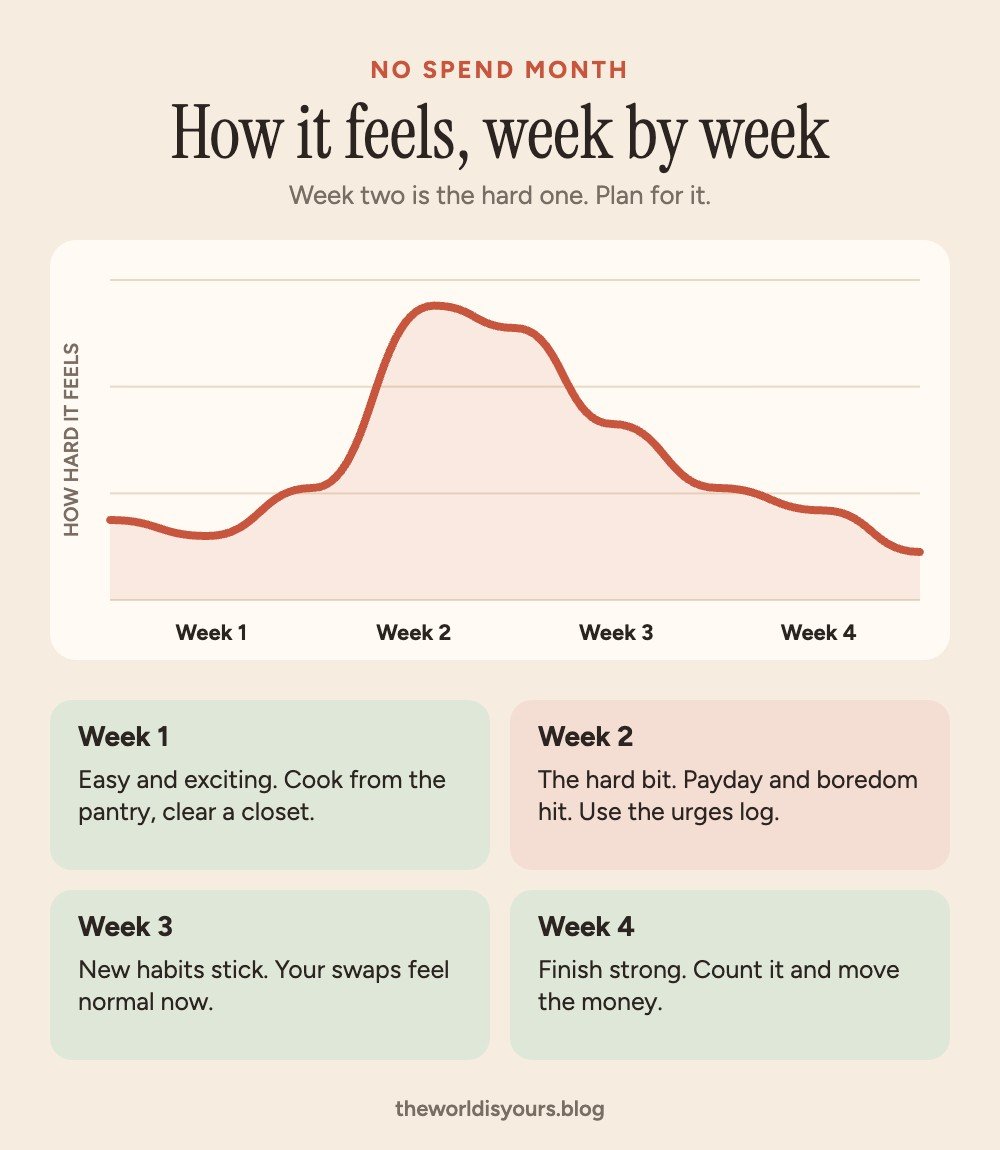
Week 1: the easy bit
Most people find the first few days surprisingly easy. You’re motivated, it’s new, and the fridge is full. Use this energy to cook from the pantry, clear out a cupboard and list things to sell.
Week 2: the hard bit
This is where it gets real. Payday often lands, boredom kicks in and the habit you didn’t know you had shows up: the coffee on the way home, the late-night scroll that ends in an order. Use the urges log. Writing “wanted: new throw pillows, $45” takes the heat out of it more than you’d think.


Week 3: new habits
By now you’ve found your swaps. You make coffee at home without thinking, you know three free things to do on a Saturday, and the wish list is doing its job: half of what’s on it, you no longer want.
Week 4: finish strong

Count up what you didn’t spend and move it straight to where you decided. Then look back at the urges log and pick two or three habits you want to keep for good.
How much can a no spend challenge save you?
It depends completely on what you usually spend. Use the calculator below with your own numbers: move the sliders to match a normal month, then pick how long your challenge is.
No spend savings calculator
Move the sliders to match a normal month for you. The total updates as you go.
Over a 31-day no spend challenge you could keep about
These are estimates from the numbers you enter, not a promise. Check last month’s bank statement for your real figures.
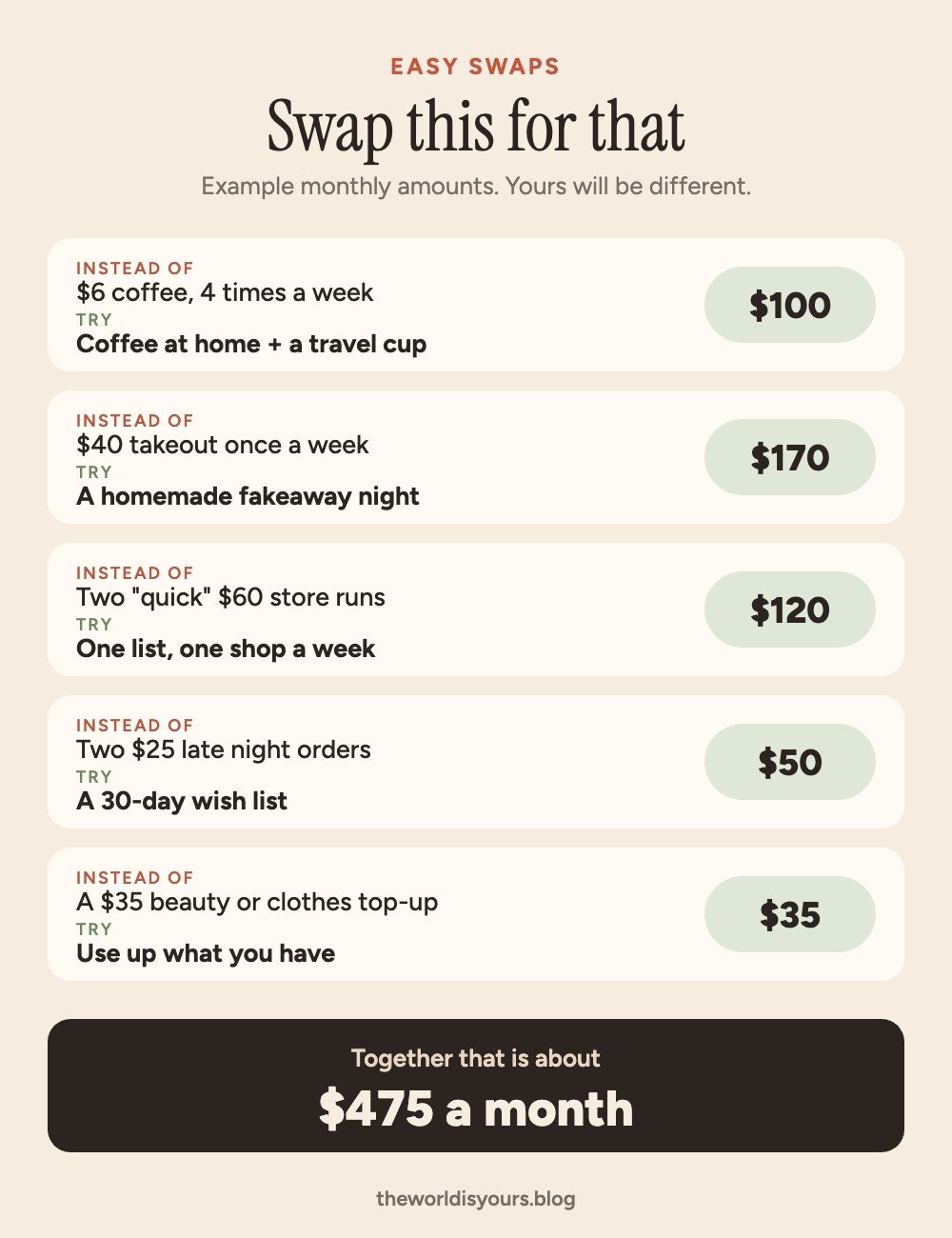
Here are the example numbers the calculator starts with, so you can see how the small stuff adds up:
| If you usually… | Over a month that’s about |
|---|---|
| Buy a $6 coffee four times a week | $100 |
| Order $40 of takeout once a week | $170 |
| Make two “quick” $60 store runs | $120 |
| Place two $25 “just because” online orders | $50 |
| Buy one $35 beauty or clothing top-up | $35 |
Those examples alone come to about $475 in a month. Yours might be more or less, but most people are surprised. Write your real number in the “money not spent” box on the tracker.
40 no spend activities (free things to do instead)
The secret to a no spend month is having a plan for the times you’d normally shop or eat out. Save the bingo card to your phone or print it, and color in a square each time you do one.
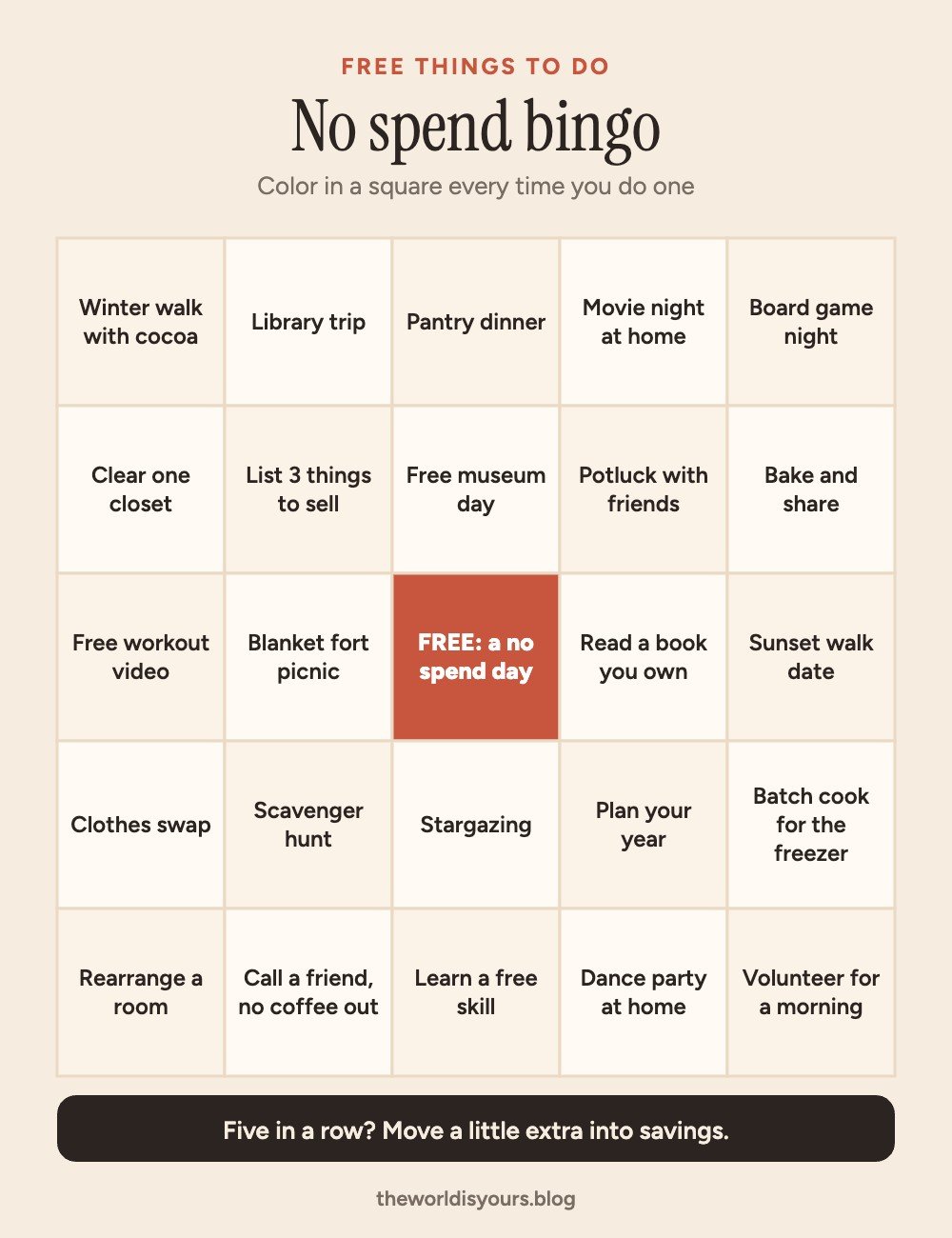
Stock up once for a month of free fun


At home
- Cook a new recipe using only what’s in the pantry
- Movie night with homemade popcorn
- Clear out one closet and list things to sell
- Start the book you’ve been meaning to read
- Do a free workout video or a long stretch
- Rearrange a room with what you already own
- Learn something free online (a language, Canva, a new skill)
- Bake bread or cookies and share them with a neighbor

Outside
- Walk a trail or park you haven’t tried
- Free museum days and free gallery openings
- Window shop with no wallet (it’s oddly fun)
- Go on a sunset or snow walk with a flask of homemade cocoa
- Volunteer for a morning
- Watch a local high school game or free community event
- Take photos around your town like a tourist

No spend activities with kids
- Library story time, then borrow a stack of books
- Build a blanket fort and have a picnic in it
- Family board game or card game tournament
- A scavenger hunt in the yard or the park
- Baking day with whatever is in the cupboard
- Arts and crafts with recycling and old magazines
- A living room dance party
- Sledding, puddle jumping or a nature collection walk
- Put on a family talent show or a puppet show

No spend date ideas
- Cook a fancy dinner at home and dress up for it
- A sunset walk with a thermos of something warm
- Movie marathon of the films you saw together first
- Stargazing from the backyard or a quiet spot
- Play a two-player game or a puzzle with music on
- Write down your plans for the year together
With friends
- Host a potluck where everyone brings a dish
- A clothes swap
- A walk-and-talk instead of coffee out
- Game night at someone’s house
- A group workout in the park

Made for January
- Make a vision board from old magazines
- Plan your year in a notebook
- Organize your digital photos into albums
- Try a 30-day free fitness or yoga plan
- Batch cook and fill the freezer for busy weeks
A no spend challenge for moms and busy families
Doing this with kids at home is a different game. The money mostly leaks in small, rushed moments: the snack on the school run, the gift for a party invite that arrived on Thursday, the store trip because someone needs new sneakers. A few things make it much easier:
- Check the school and party calendar first. Buy or make the gifts you need before you start, so they count as planned.
- Keep a gift drawer. A few simple wrapped gifts and cards bought on sale means a surprise invite doesn’t break the streak.
- Shop once, with a list, without the kids if you can. Online grocery pickup with a strict list works well too.
- Make it a family goal. A jar on the counter for “what we didn’t spend” and a fun free reward at the end (a family movie marathon, a beach day in summer) gets kids on board.
- Pack snacks and water for every outing so the drive-thru doesn’t win.
- Use the low spend version. A small weekly treat budget isn’t cheating. It’s what makes it doable.

Swaps that make it easier
| Instead of… | Try… |
|---|---|
| Coffee shop on the way to work | A good mug of coffee at home and a travel cup |
| Friday takeout | A “fakeaway” night: homemade pizza, tacos or a stir-fry |
| Adding to cart at 11pm | Adding it to a 30-day wish list |
| Buying a new outfit for an event | Shopping your closet, or a swap with a friend |
| New beauty products | Using up what’s half-finished in the drawer |
| A Target wander | A walk, a library trip or a call with a friend |

Make coffee at home feel like a treat


The 30-day wish list
This is the most useful habit to keep after the challenge ends. When you want something that isn’t essential, write it down with the date and the price, and wait 30 days. If you still want it and it fits your plan, buy it then. Most of the list quietly stops mattering.

Make the apps harder to reach
Shopping apps are built to make spending easy. For the month, delete them, remove saved cards from your browser and turn off sale notifications. You can always put them back. You probably won’t want to.

What to do if you slip up
You will probably slip at least once. That’s fine. Write it on the urges log, notice what triggered it (tired, bored, stressed, payday) and carry on with the next day. One unplanned $12 lunch doesn’t undo three weeks of saving. Quitting because of it does.
A no spend challenge on a low income
If money is already tight, there may not be much “extra” to cut, and that’s not a personal failing. In that case the low spend version makes more sense: focus on one or two leaks, like fees, unused subscriptions or delivery charges, rather than making life miserable. Never skip essentials like food, medicine or heating to hit a streak. Our low income savings challenge has gentler ideas that still build a cushion.
Where to put the money you save
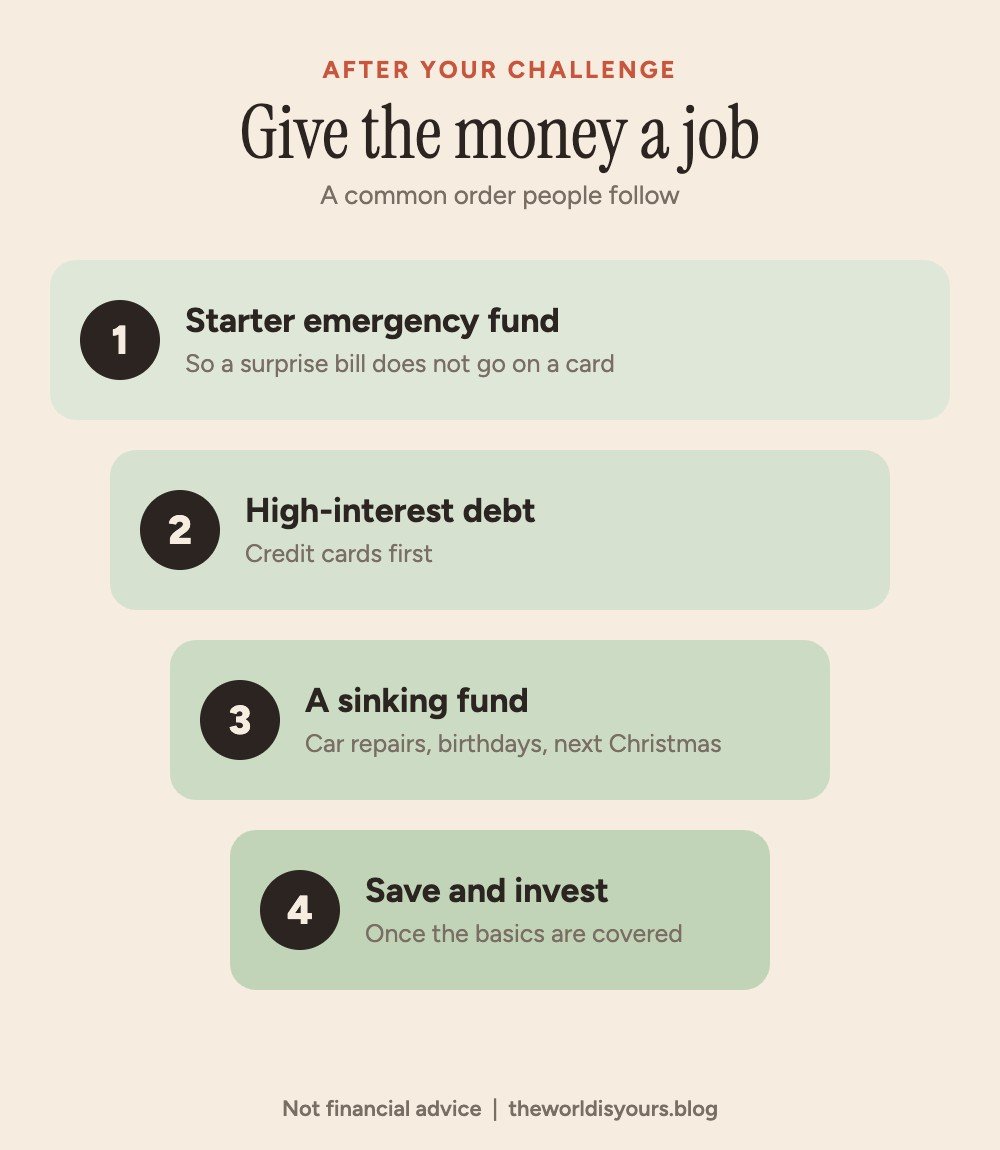
This is the part that turns a fun challenge into real progress. Move the money the same day you count it, before it blends back into everyday spending. A common order people use:
- A starter emergency fund, so the next surprise bill doesn’t go on a card.
- High-interest debt, like credit cards.
- A sinking fund for something you know is coming: car repairs, birthdays, next Christmas.
- Long-term saving and investing once the basics are covered. Start with our investing for beginners guide, the Roth IRA guide if you’re in the US, or the stocks and shares ISA guide if you’re in the UK.
I’m not a financial advisor, and the right order depends on your situation, so treat this as a starting point.
Track every dollar you save


After the challenge: what to keep
Most people don’t go back to exactly how they were. Pick a few habits to keep: the wish list, coffee at home on weekdays, one no spend weekend a month, or a regular savings challenge. If you want something to do next, try the 52-week money saving challenge, build a money saving plan or grab a few budgeting hacks.
Books that make money habits stick


Questions people ask
What are the rules of a no spend challenge?
You only pay for essentials, like housing, bills, groceries from a list, transport and medicine, and cut everything extra, like takeout, coffee runs, online shopping and new clothes. Write down what’s allowed and what isn’t before you start, and decide on grey areas in advance.
How long should a no spend challenge be?
A weekend or a week is a good first try. A full month is the classic, and January is the most popular month for it. If you have kids or a tight budget, a low spend month with a small weekly treat budget is easier to stick to.
Can you buy groceries on a no spend challenge?
Yes. Groceries are an essential, but shop from a list built around what’s already in your pantry and freezer, and skip the extras. Many people combine a no spend month with a pantry challenge to cut the grocery bill too.
How much money can you save with a no spend month?
It depends on what you usually spend on extras. Small things add up fast: a few coffees, one takeout night a week and a couple of online orders can easily come to a few hundred dollars a month. Check last month’s statement to see your own number.
What should I do with the money I save?
Move it the same day you count it. A starter emergency fund, high-interest debt or a sinking fund for something coming up are the usual first choices, then longer-term saving and investing.
Is there a free no spend challenge tracker?
Yes. You can download a free printable 31-day no spend challenge tracker in US Letter and A4 from this post, with no sign-up. It includes a calendar, can spend and won’t spend lists and an urges log.
Keep going: saving money tips, frugal living tips, how to save money on groceries and how to stop wasting money.