A budget planner is a simple page where you write down the money coming in each month, the bills going out, and a plan for everything left, so every dollar has a job before the month starts. You can grab a free printable monthly budget planner below (US Letter and A4, no sign-up), then follow the six steps to make a family budget that actually fits real life with kids, rising grocery bills and paychecks that never seem to stretch far enough.
This post contains affiliate links. If you buy through them I may earn a small commission at no extra cost to you. As an Amazon Associate I earn from qualifying purchases. Some photos are AI generated to show the idea. I’m not a financial advisor, so treat this as general information, not financial advice.
- Download the free budget planner: a monthly budget page, a bill tracker with sinking funds, and a spending tracker.
- Start with take-home pay, then list fixed bills, then look at what you really spent last month.
- Plan everyday spending honestly, then give every leftover dollar a job (savings, sinking funds or extra on a debt).
- Pick one method: 50/30/20, zero-based, cash envelopes, paycheck budget or pay yourself first.
- Check in for 10 minutes a week and have a 30-minute money date once a month.
Free printable budget planner (monthly + family)
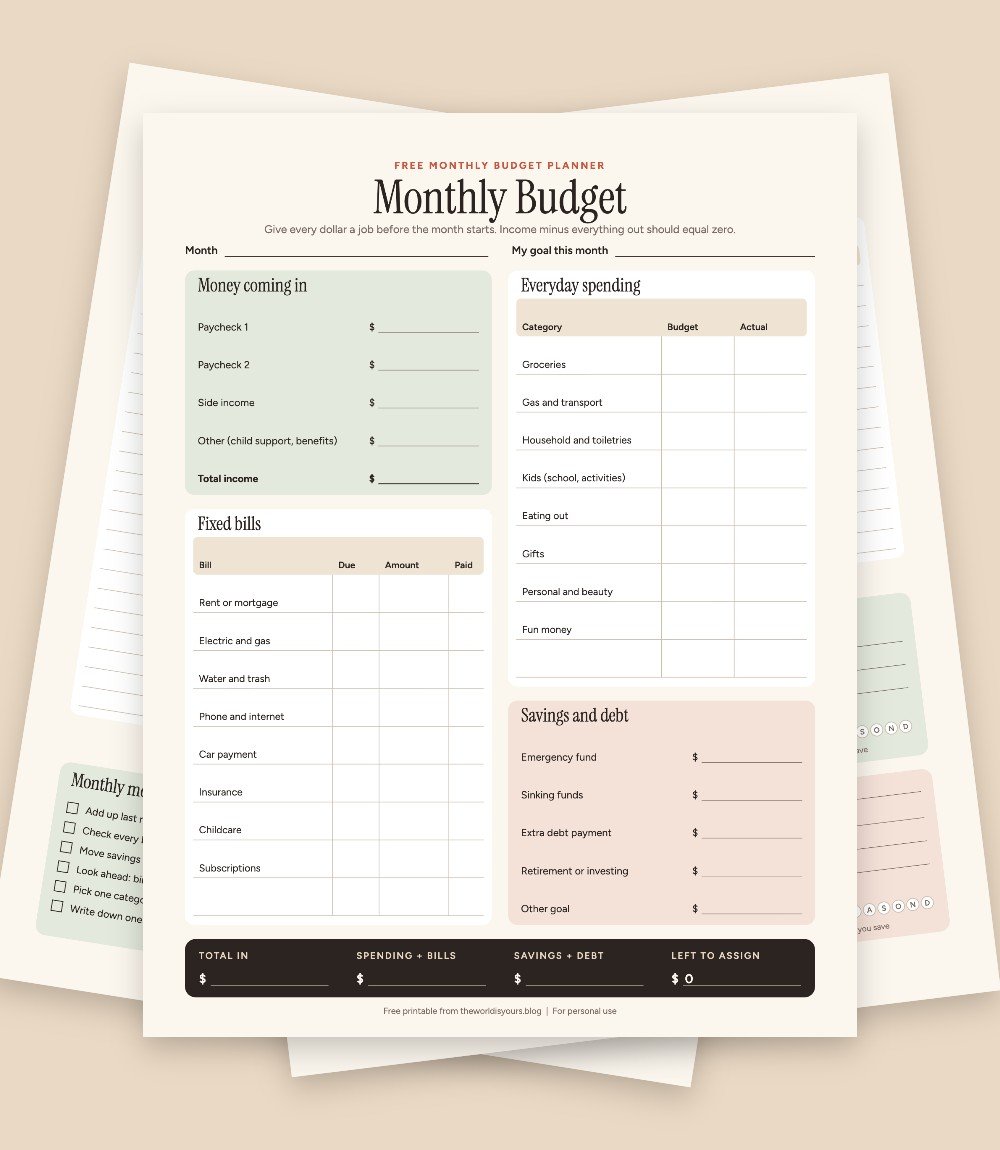
This is the planner I’d print for a family budget. It’s three pages, and each one does a different job:
- Monthly budget: money coming in, fixed bills with due dates, everyday spending with a budget and actual column, savings and debt, and a bar at the bottom to check that everything adds up.
- Bills and sinking funds: a bill tracker so nothing gets missed, plus six sinking fund cards (Christmas, birthdays, car repairs, back to school, vacation and one of your own) with a circle to color in each month you save.
- Spending tracker: a simple log of what you bought, plus a monthly money date checklist and a box for what you’ll change next month.
It comes in US Letter and A4, it’s free, and there’s no email sign-up. Print one set a month, or print page two once and keep it for the year.
Keep your budget in one place


What is a budget planner, and do you need one?
A budget planner is just a plan for your money, written down. It shows what’s coming in, what has to go out, and what you’ve decided to do with the rest. A budget isn’t a punishment or a list of things you can’t have. It’s you telling your money where to go instead of wondering where it went.
You don’t need a fancy app. Plenty of people find paper works better, because writing numbers by hand makes you actually look at them. Apps are great for tracking, but a printed page on the fridge or in a binder is hard to ignore, and the whole family can see it.

| Paper budget planner | Budget app or spreadsheet |
|---|---|
| Easy to start tonight, nothing to set up | Does the math for you |
| Writing it down helps it stick | Can link to your bank and track automatically |
| Everyone in the house can see it on the fridge | Easy to check from your phone |
| Free with a printable | Some apps charge a monthly fee |
Lots of families use both: a paper planner for the plan and a quick weekly check of the bank app to see how it’s going.
How to make a family budget in 6 steps
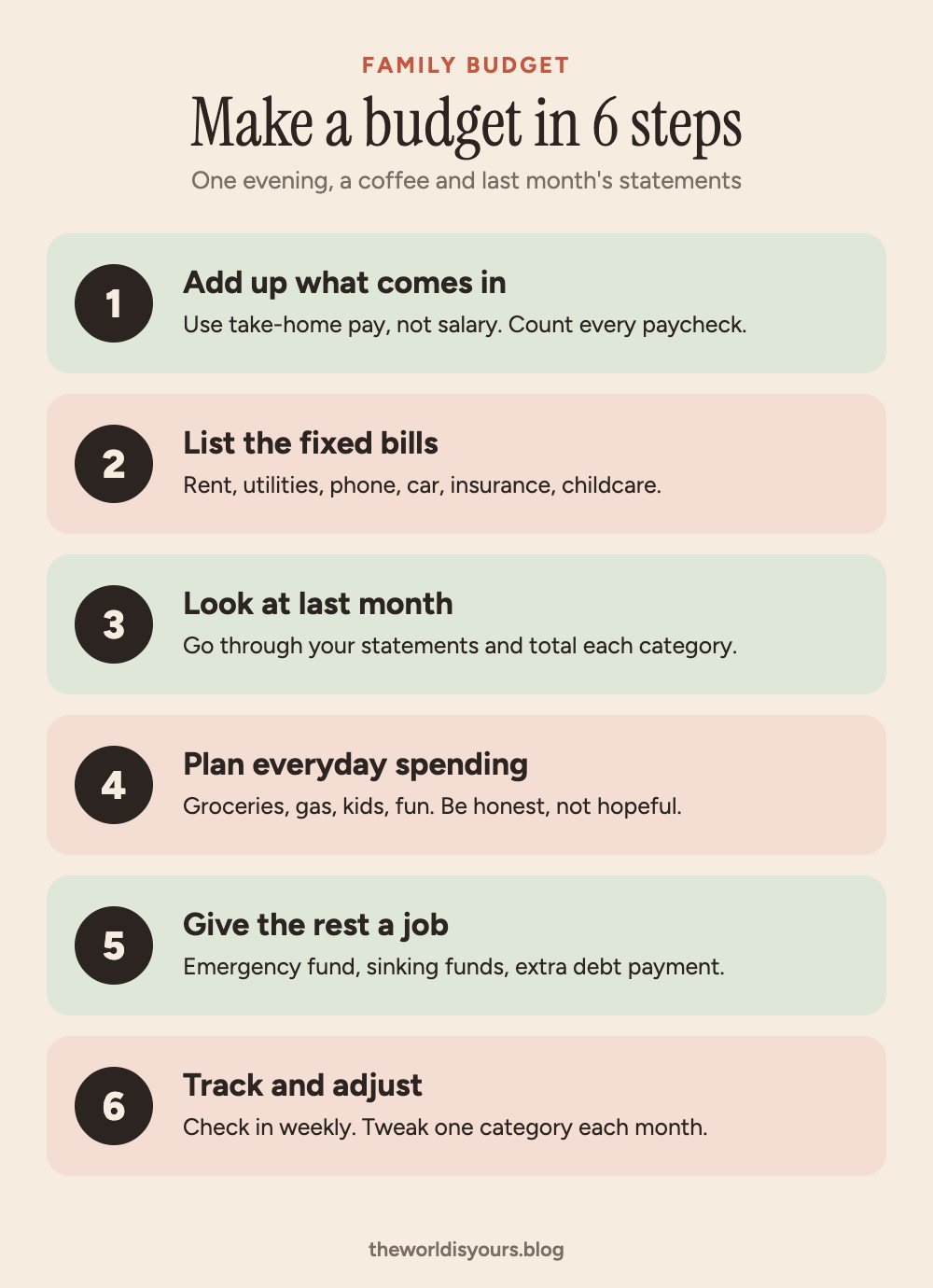
Set aside one evening, make a coffee, and pull up last month’s bank and card statements. The first budget takes about an hour. After that it’s more like 30 minutes a month.
Sort the paperwork once


Step 1: Add up the money coming in

Use take-home pay, the amount that actually lands in your account after tax and deductions. Write down each paycheck separately, plus any side income, child support or benefits. If your pay changes month to month, use your lowest normal month. Anything extra that comes in is a bonus you can give a job later.
Step 2: List your fixed bills

Fixed bills are the ones that cost about the same every month: rent or mortgage, utilities, phone, internet, car payment, insurance, childcare and subscriptions. Write each one on the planner with its due date. Seeing due dates next to paydays shows you straight away if a bill lands at an awkward time, and many companies will move a due date if you ask.
Step 3: Look at what you really spent last month

This is the step most people skip, and it’s the one that makes a budget work. Go through last month’s statements and highlight everything in a color per category: groceries, gas, eating out, kids, online orders. Add each color up. Don’t judge it. You’re just finding out where the money goes so your plan is based on real numbers, not hopeful ones.
Step 4: Plan your everyday spending

Now set a budget for each everyday category using what you found in step three. If you spent $1,000 on groceries and want to spend less, try $900 this month rather than $600. Small cuts stick. Big ones usually last about a week.

Step 5: Give every leftover dollar a job

Take income, subtract bills and everyday spending, and see what’s left. That money needs a job too, or it quietly disappears. Common jobs, in the order a lot of people follow: a starter emergency fund, extra payments on high-interest debt, sinking funds for things you know are coming, then longer-term saving and investing. When income minus everything you’ve planned equals zero, you’ve made a zero-based budget.
Step 6: Track it and adjust

Write down what you spend on the tracker page, or check your bank app once a week. When a category runs over, move money from another one rather than giving up. Your first budget will be wrong somewhere, and that’s normal. By month three it will feel a lot more like your real life.
Family budget categories (and what goes in each)
Use these as a starting point and rename them to fit your home. The fewer categories you have, the easier it is to keep up.
| Category | What goes in it | Tip |
|---|---|---|
| Housing | Rent or mortgage, HOA, renters or home insurance | Usually your biggest number, so check it first |
| Utilities | Electric, gas, water, trash, phone, internet | Ask about budget billing to even out winter bills |
| Groceries | Food, cleaning supplies, diapers | Shop from a list built around what’s already in the pantry |
| Transport | Gas, car payment, insurance, transit, parking | Put car repairs in a sinking fund |
| Kids | Childcare, school lunches, activities, clothes | Ask what’s coming up at school each month |
| Health | Copays, prescriptions, dental, glasses | Keep a small buffer for surprise visits |
| Debt | Minimum payments on cards and loans | Any extra goes in savings and debt |
| Fun and eating out | Takeout, date nights, streaming, hobbies | Give it a real number so it doesn’t sneak |
| Personal | Haircuts, beauty, clothes for you | A small amount each month beats guilt splurges |
| Savings and goals | Emergency fund, sinking funds, retirement | Move it on payday, not at the end of the month |
Pick a budgeting method that fits you
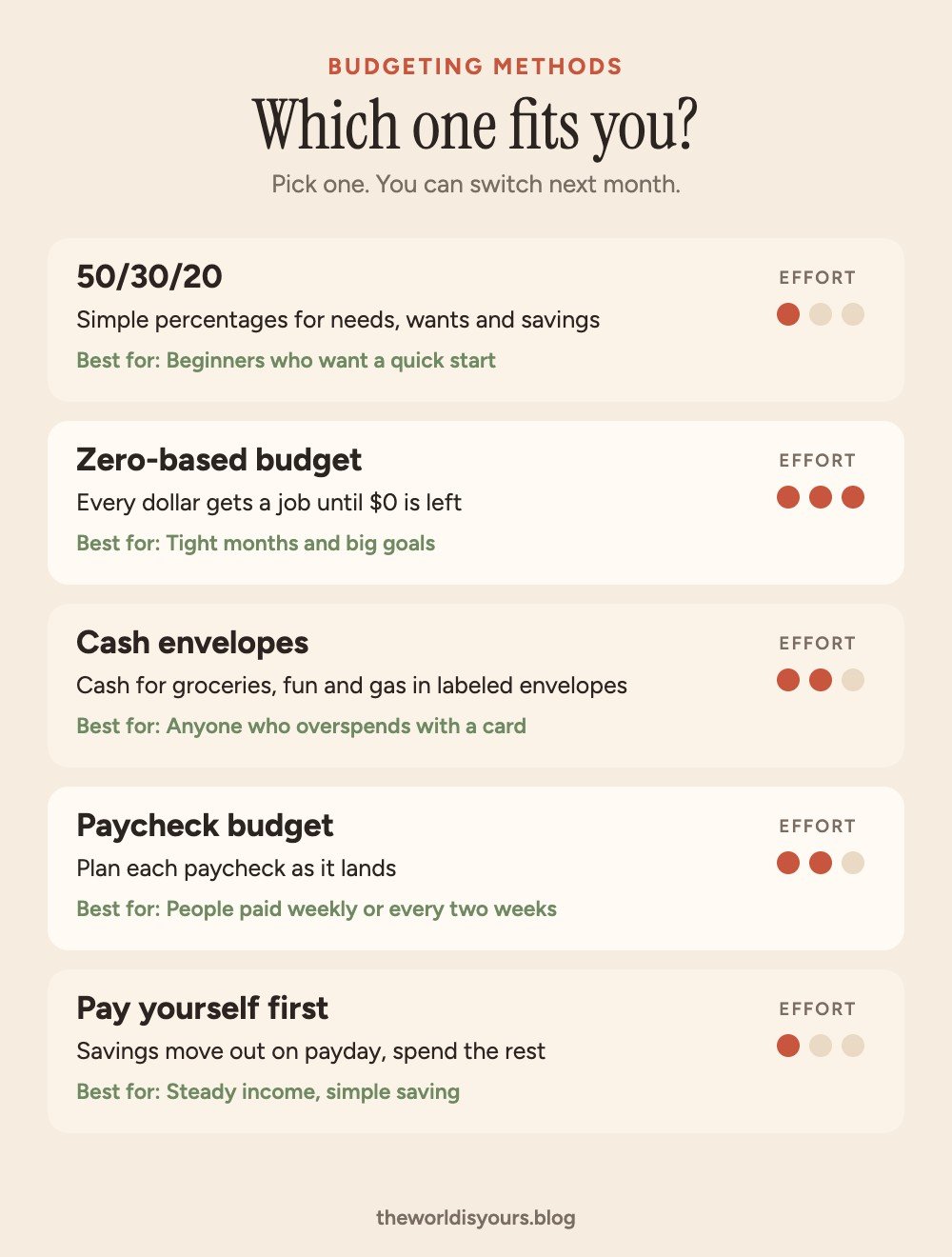
There’s no single right way to budget. The best method is the one you’ll still be using in March. Here’s how the popular ones compare:
| Method | How it works | Best for | Effort |
|---|---|---|---|
| 50/30/20 | Half to needs, 30% to wants, 20% to savings and extra debt | A quick, simple start | Low |
| Zero-based budget | Income minus every planned dollar equals zero | Tight months and big goals | Higher |
| Cash envelopes (cash stuffing) | Cash for groceries, gas and fun goes in labeled envelopes | Anyone who overspends on a card | Medium |
| Paycheck budget | You plan each paycheck as it arrives | People paid weekly or every two weeks | Medium |
| Pay yourself first | Savings move out on payday, you spend what’s left | Steady income, simple saving | Low |
Try the cash envelope method

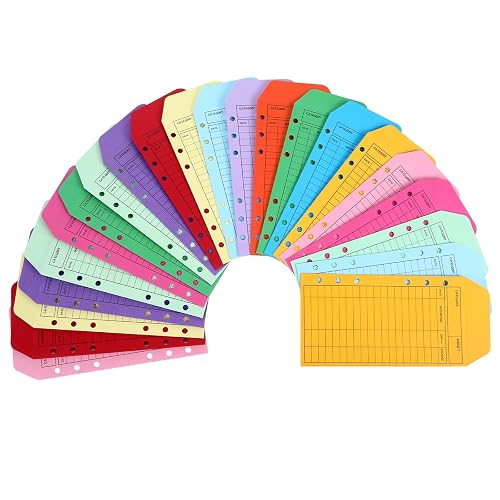

Trying the cash envelope method

Cash envelopes work because you can see the money running out. Take out cash for two or three categories you tend to overspend on, usually groceries, eating out and fun money, and put it in labeled envelopes. When an envelope is empty, that category is done until next payday. You don’t have to use cash for everything. Bills can stay on autopay.
The 50/30/20 rule with real family numbers
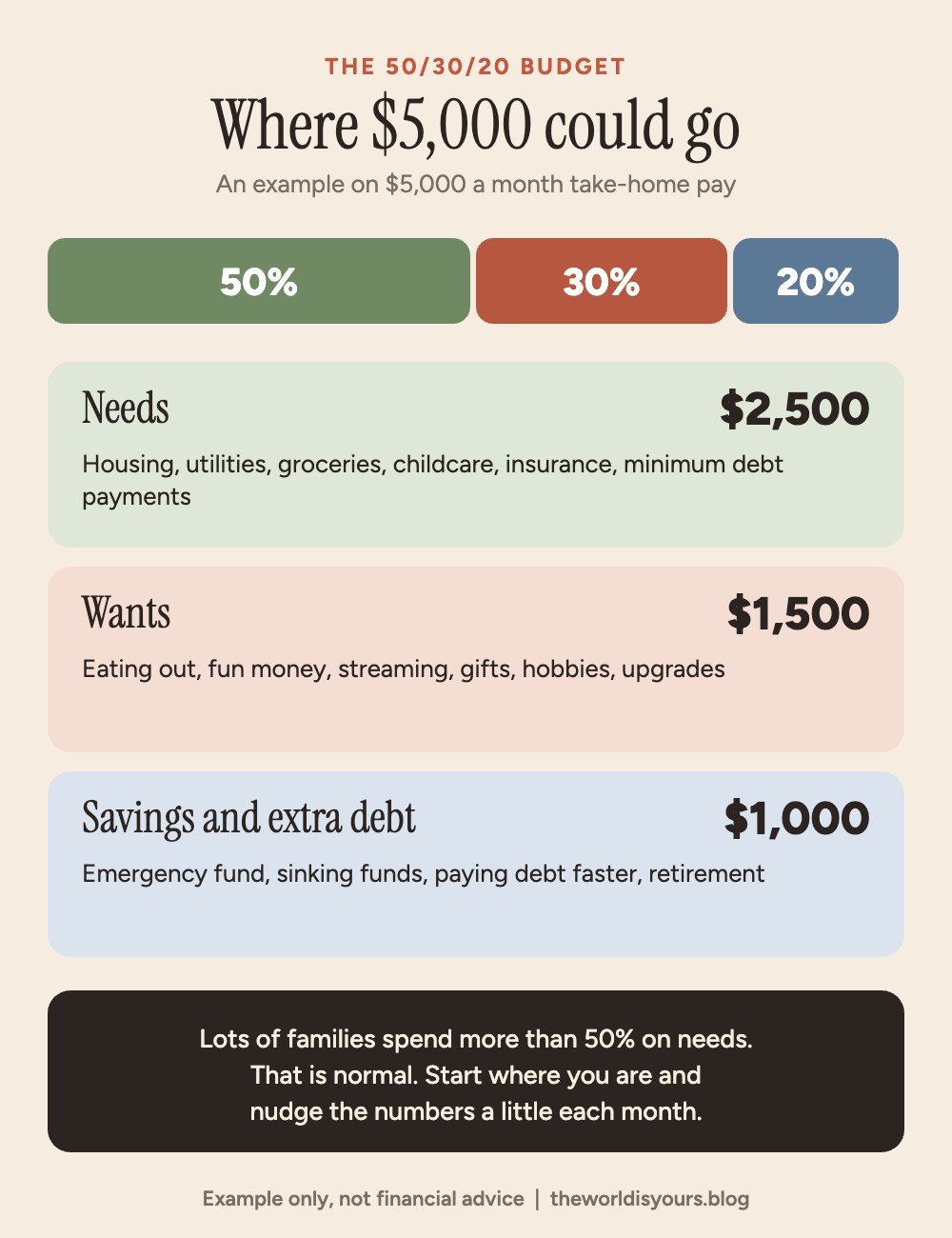
The 50/30/20 rule splits take-home pay into three buckets: about 50% for needs, 30% for wants and 20% for savings and paying debt faster. On $5,000 a month that would be $2,500 for needs, $1,500 for wants and $1,000 for savings and extra debt.
Here’s the honest part: with rent, childcare and groceries where they are, a lot of families spend well over 50% on needs. That doesn’t mean you’ve failed. It means the rule is a guide, not a test. Use it to spot where you could nudge things, like moving $50 from wants to savings this month. Try your own numbers in the calculator below.
Family budget calculator
Put in your monthly take-home pay, then move the sliders to match a normal month. It shows what is left to give a job, and how you compare with the 50/30/20 rule.
Left to give a job
These are estimates from the numbers you enter, not a promise or financial advice. The white line on each bar is the 50/30/20 guide. Plenty of families spend more than half on needs, and that is okay: use it to spot one thing to nudge.
Sinking funds: no more surprise months
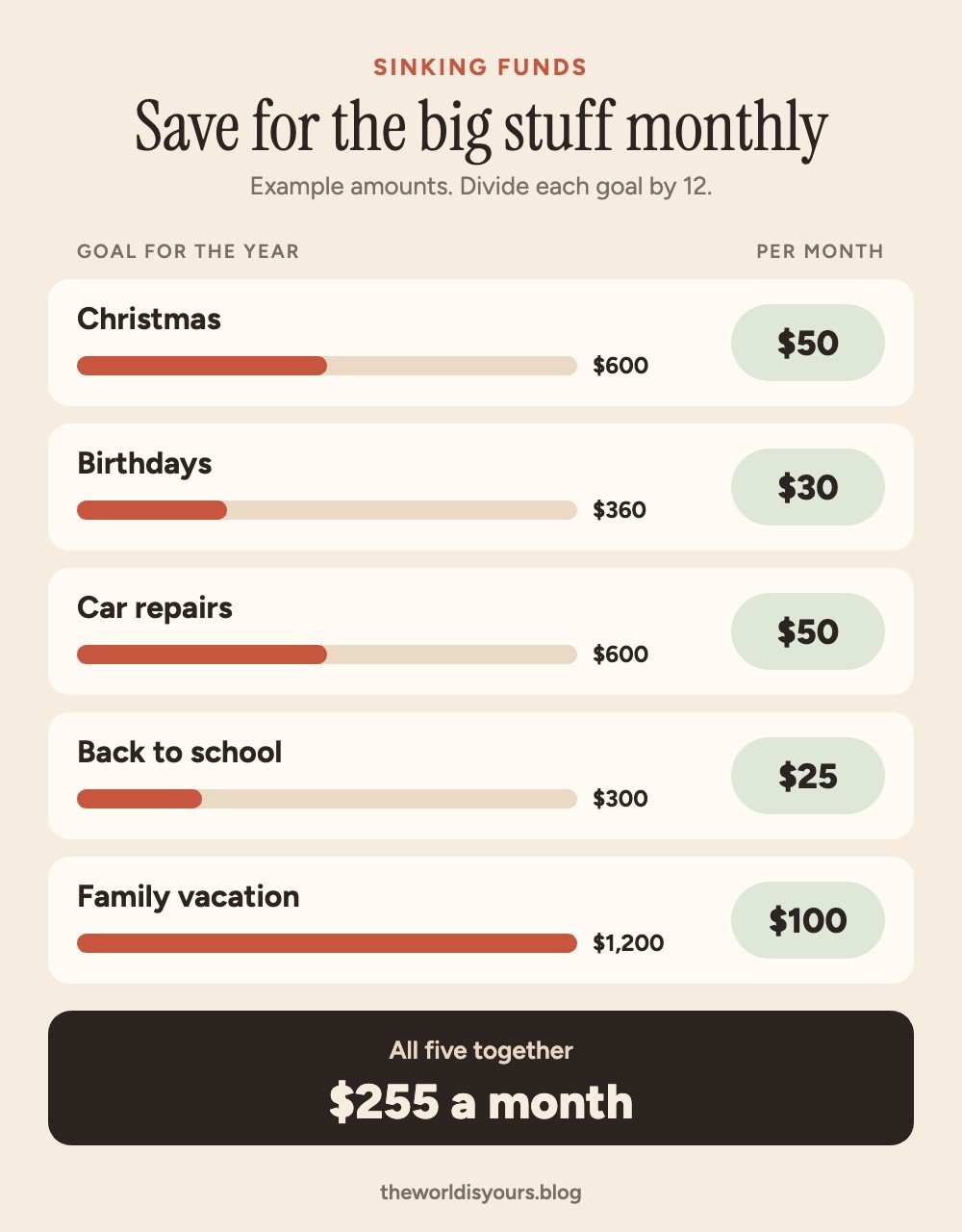
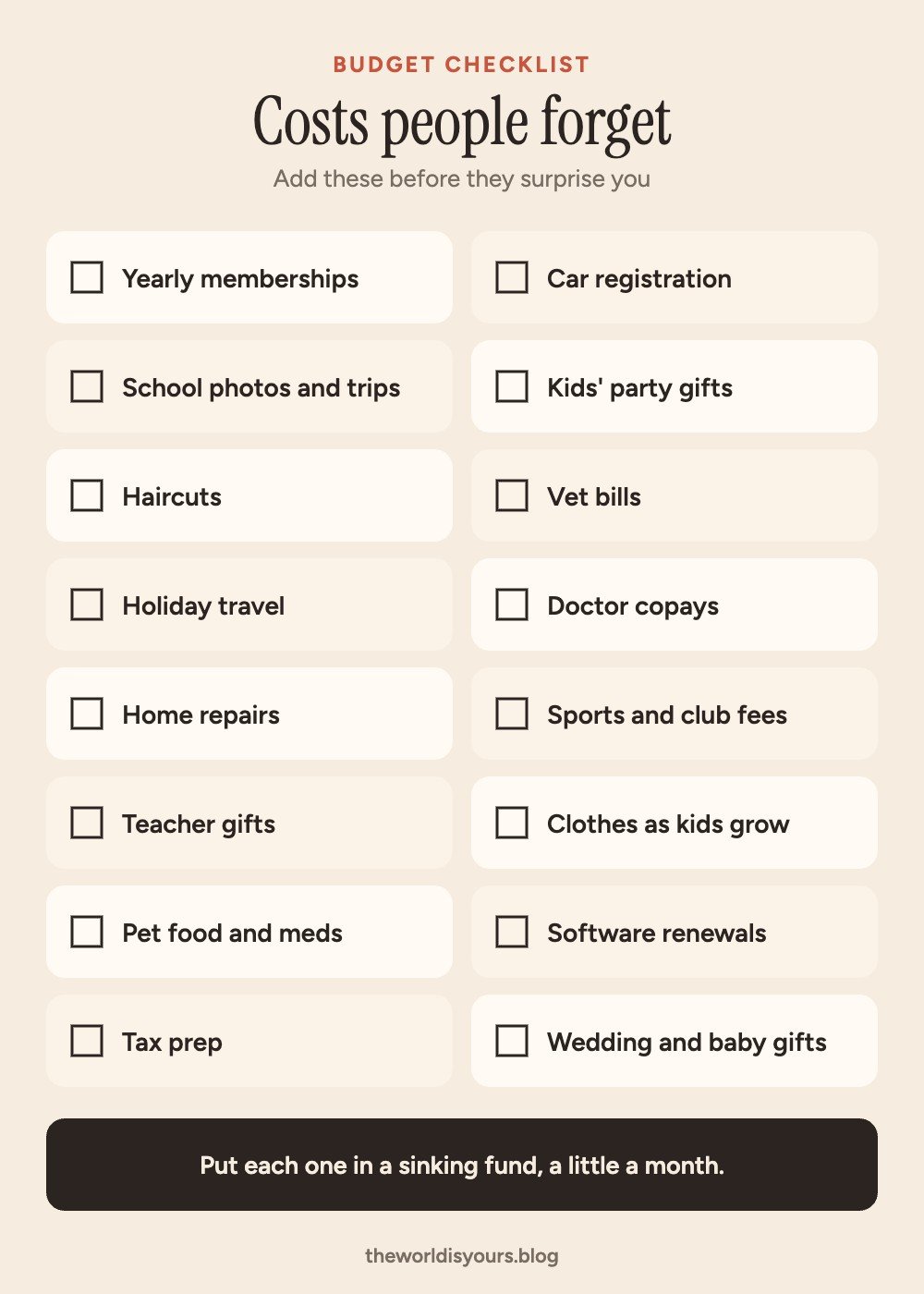
A sinking fund is money you set aside a little at a time for a cost you know is coming. Christmas isn’t an emergency, and neither are birthdays, car registration or back to school, but they feel like one when they all land at once. Divide each goal by the months you have left and save that amount every month.

| Sinking fund | Example goal for the year | Save each month |
|---|---|---|
| Christmas | $600 | $50 |
| Birthdays | $360 | $30 |
| Car repairs and registration | $600 | $50 |
| Back to school | $300 | $25 |
| Family vacation | $1,200 | $100 |
These are just examples, so swap in your own goals. Many banks let you open free extra savings accounts or “buckets” and nickname them, which keeps each fund separate from your spending money. If the full amount feels like too much, start with the one that stressed you out most last year.
Give each fund its own home


Budgeting on a tight or irregular income
If money is tight, a budget matters more, not less. These tweaks help:
- Budget from your lowest month. If your hours or tips change, plan on your lowest normal income and treat anything extra as a bonus to give a job.
- Plan by paycheck. If you’re paid every two weeks, write a mini budget for each paycheck and decide which bills each one covers.
- Cover the four walls first. Housing, utilities, food and transport come before anything else.
- Start the emergency fund small. Even $10 or $20 a paycheck adds up, and it means a surprise bill doesn’t go straight on a card.
- Look for help you qualify for. Utility assistance programs, school meal programs and local food banks exist for exactly these months.
If a month comes out negative on paper, that’s useful information, not a failure. It tells you to trim a want, call a provider about a lower rate, or look at ways to bring in a little more, like these side hustle ideas you can do from home.
Budgeting as a busy mom
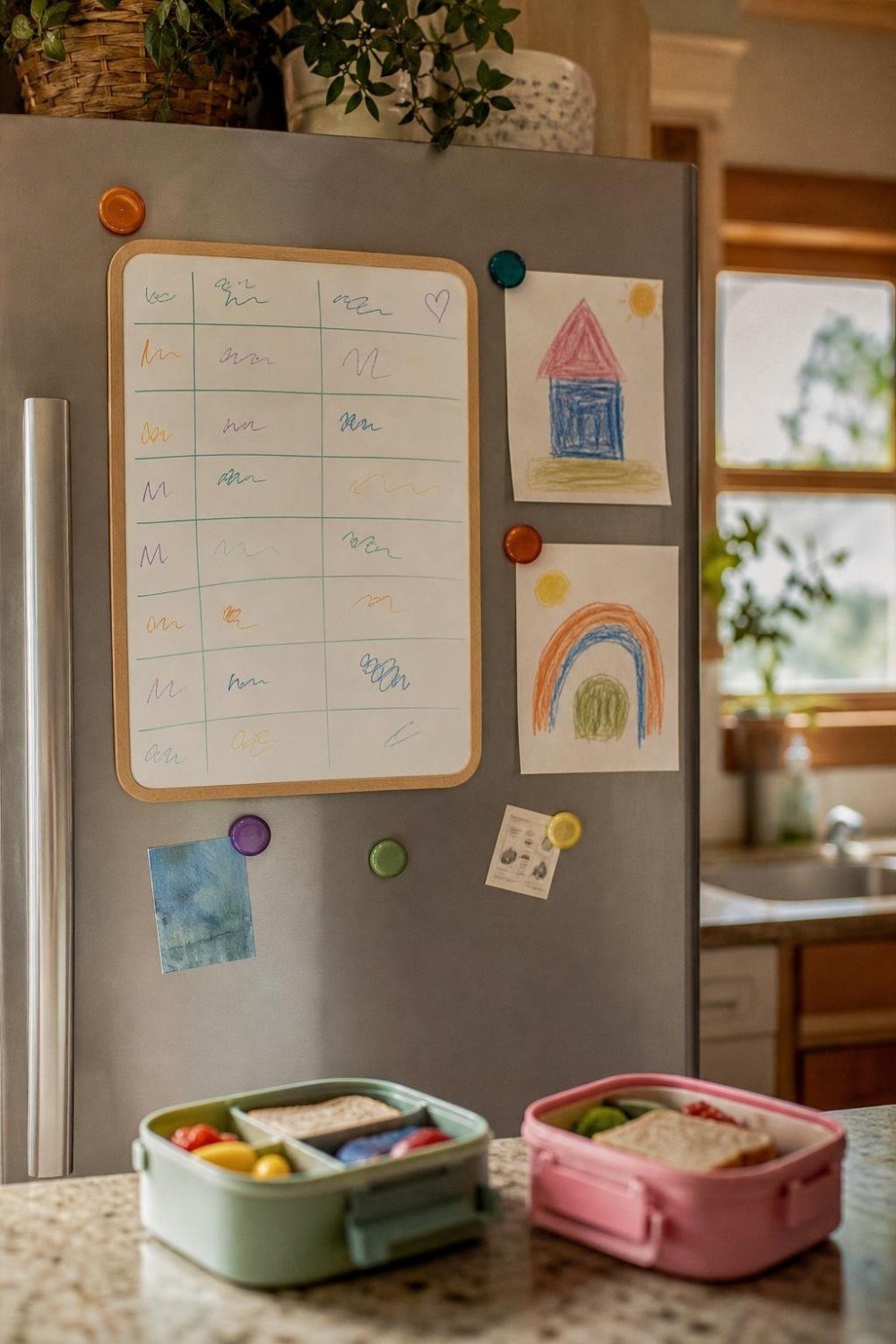
When you’re running a household, the budget can’t be another big job. Keep it small:
- One 10-minute check a week. Sunday night, look at the bank app and add up the week on the tracker.
- Plan meals before you shop. A simple weekly meal plan is one of the biggest grocery savers there is. Our guide to saving money on groceries has more.
- Make it a family thing. Older kids can help pick the fun money plans for the month, which is a great money lesson.
- Give yourself a little. A small personal line in the budget, even $20, makes it far easier to stick to the rest without feeling guilty.
Make meal planning easier


Your monthly money date
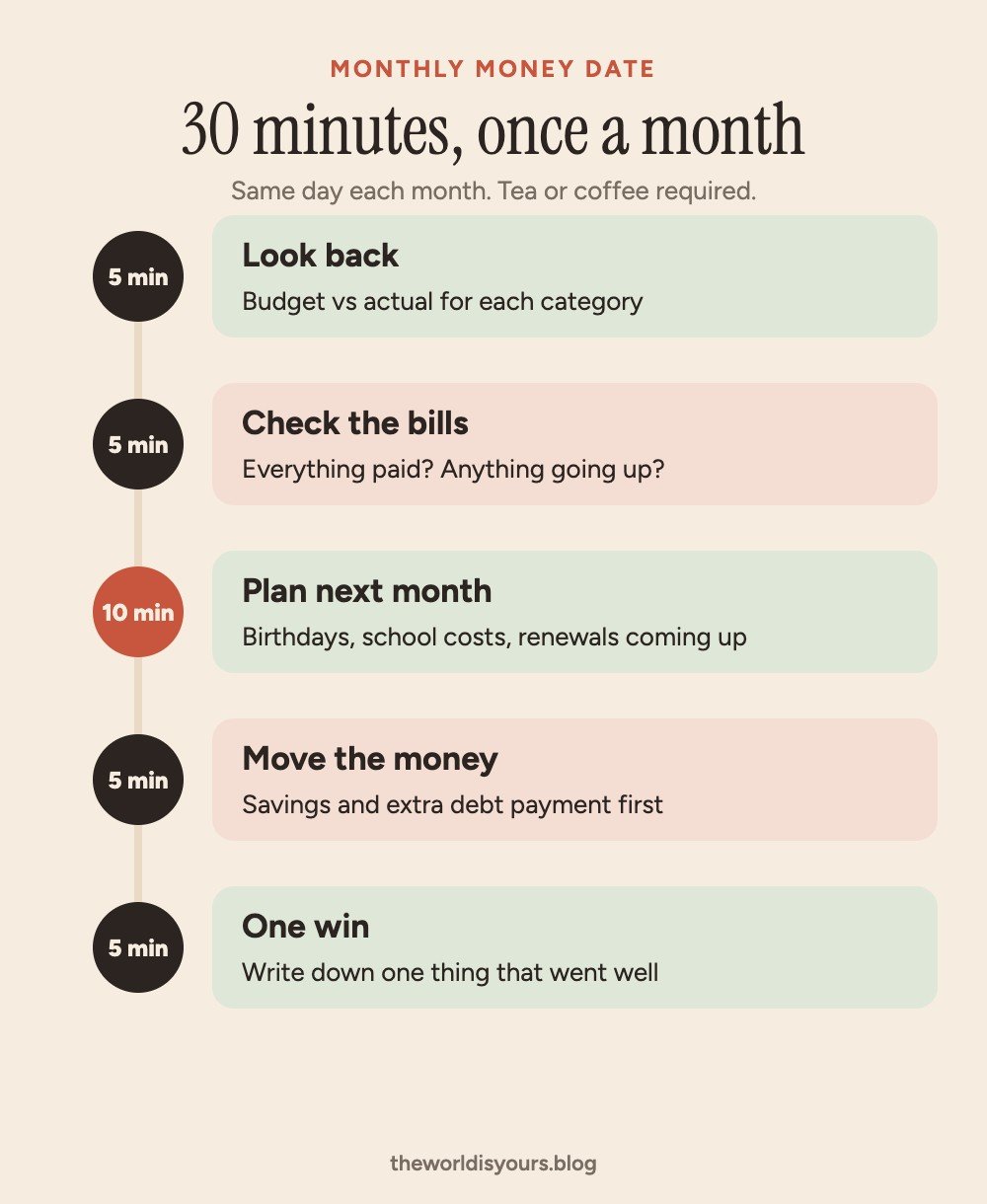
Once a month, ideally a few days before the month starts, sit down for half an hour and walk through the checklist on page three of the planner: look back at last month, check every bill got paid, plan the month ahead, move the money, and write down one win. If you share money with a partner, do it together with a coffee or a glass of wine. It’s much nicer than a money argument later.

Books that make budgeting click



Common budget mistakes (and easy fixes)
| Mistake | Easy fix |
|---|---|
| Using salary instead of take-home pay | Budget from what actually lands in your account |
| Guessing instead of checking last month | Spend 20 minutes with your statements first |
| Forgetting yearly and irregular costs | Add sinking funds for them |
| Making the budget too strict | Leave some fun money so you don’t quit |
| Giving up after one bad month | Adjust the numbers and try again next month |
| Leaving leftover money without a job | Move it to savings or debt on payday |
If you want a quick reset before your first budget, a no spend challenge is a great way to see where money leaks, and our budgeting hacks have more small wins.
Frequently asked questions
What is the best budget planner for beginners?
A simple monthly budget planner with income, bills, everyday spending and savings on one page is the easiest place to start. You can download a free printable budget planner from this post in US Letter and A4, with no sign-up.
How do I make a family budget?
Add up your take-home pay, list your fixed bills, look at what you actually spent last month, plan your everyday spending, give every leftover dollar a job, then track and adjust each week. The first budget takes about an hour.
What is the 50/30/20 rule?
It’s a guide that puts about 50% of take-home pay toward needs, 30% toward wants and 20% toward savings and paying debt faster. Many families spend more than 50% on needs, so use it as a starting point rather than a strict rule.
What categories should be in a family budget?
Most family budgets include housing, utilities, groceries, transport, kids, health, debt, fun and eating out, personal spending, and savings and goals. Add sinking funds for yearly costs like Christmas, birthdays and car repairs.
How much should a family spend on groceries?
It depends on family size, where you live and what you eat, so start with what you spent last month and trim it a little at a time. Shopping from a list, planning meals and cooking from the pantry are the easiest ways to bring it down.
Is a paper budget planner better than an app?
Neither is better for everyone. A paper planner is free, quick to start and easy for the whole family to see, while an app does the math and tracks spending automatically. Many people plan on paper and track in their bank app.
Keep going: no spend challenge, money saving challenges, low income savings challenge, how to make a money saving plan, budgeting hacks and saving money tips.