A debt payoff plan is a simple list of everything you owe, an order to pay it off in, and a set amount you put toward it every month until it’s gone. Pay the minimum on every debt, put every spare dollar on one target debt, and when that one is paid off, roll its payment into the next: that’s the whole method, whether you use the debt snowball or the debt avalanche. Below you’ll find both methods in plain English, a real example with the math, a calculator, and a free debt payoff tracker printable (US Letter and A4, no sign-up).
This post contains affiliate links. If you buy through them I may earn a small commission at no extra cost to you. As an Amazon Associate I earn from qualifying purchases. Some photos are AI generated to show the idea. I’m not a financial advisor: this is general information to help you plan, not financial or legal advice. If you’re behind on payments or facing collections, talk to a nonprofit credit counselor first.
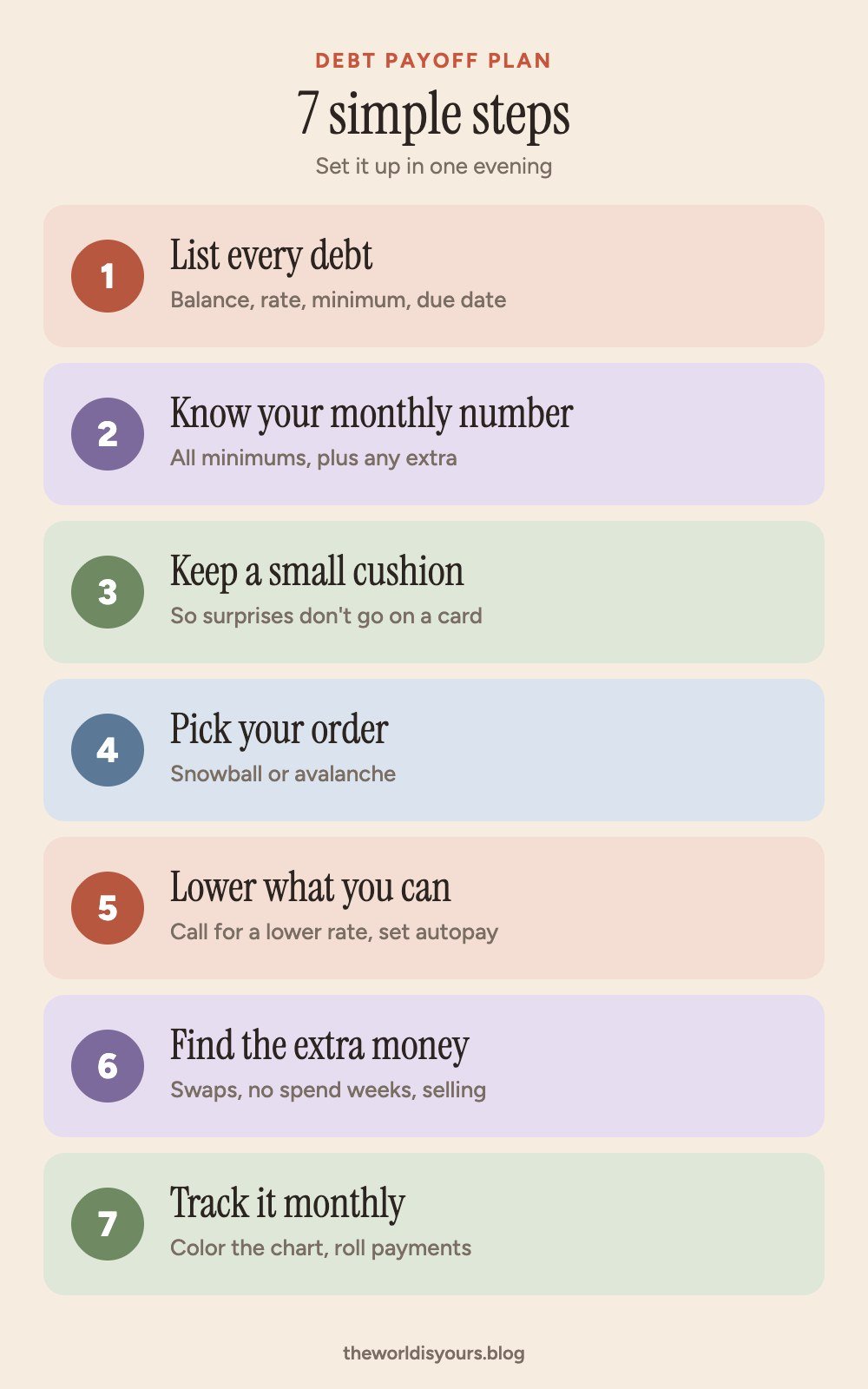
- List every debt: balance, interest rate, minimum payment and due date.
- Pay the minimum on all of them so nothing goes late.
- Pick one target: smallest balance first (snowball) or highest interest first (avalanche).
- Put every extra dollar on the target. When it’s gone, roll that whole payment into the next one.
- Stop adding new debt while you pay it down, and keep a small cushion for emergencies.
- Track it where you’ll see it. The free tracker below has a debt list, a payoff chart for each debt and a monthly log.
Free debt payoff tracker printable
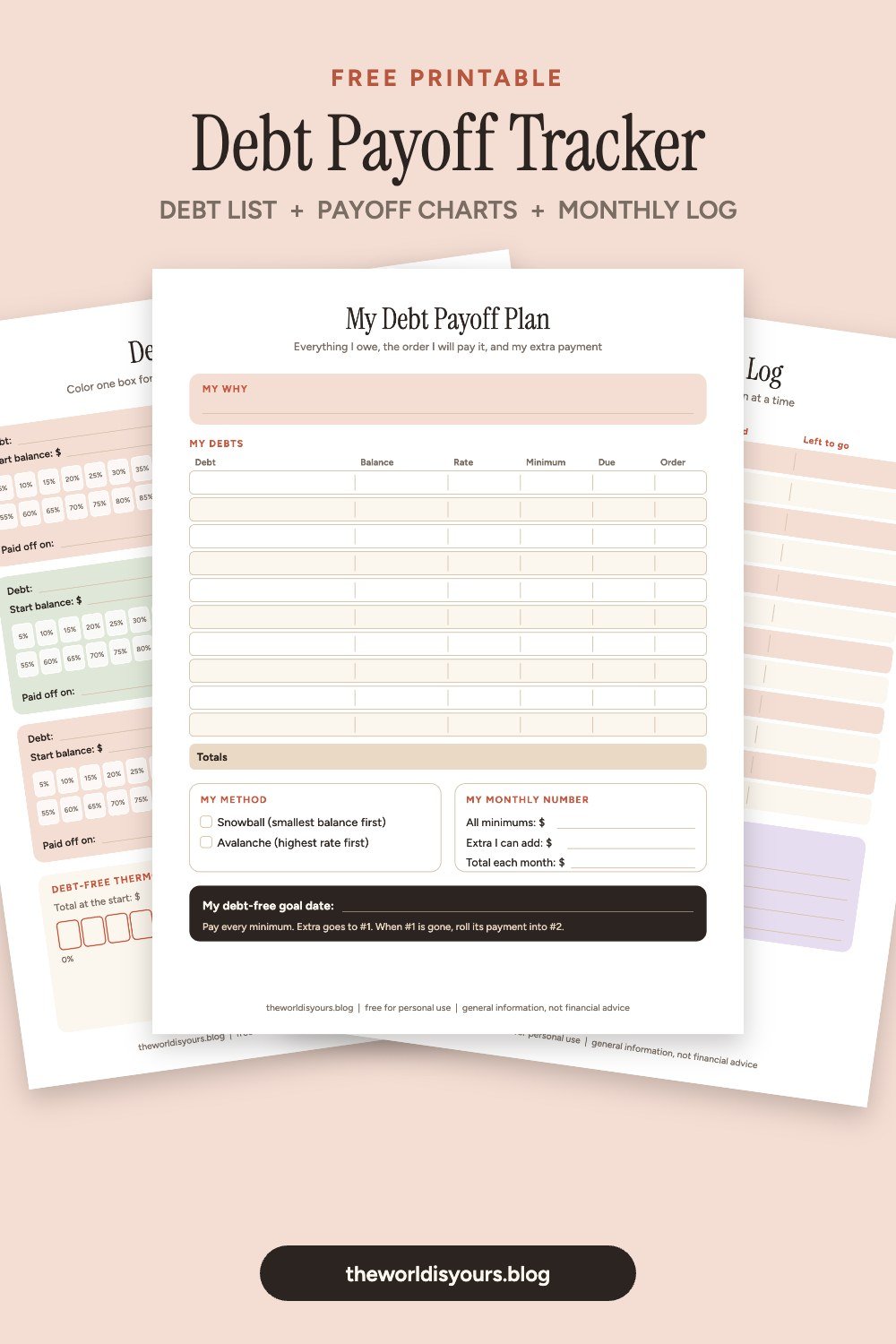
I made this tracker to be the one page you actually keep looking at. Paying off debt is slow, and seeing boxes fill up is what keeps most people going on the boring months.
It’s three pages:
- My debt list and plan: every debt with its balance, rate, minimum and due date, a box to number your payoff order, your method, your extra payment and your debt-free goal date.
- Debt payoff charts: six cards, one per debt, each with 20 boxes to color in (every box is 5% of that balance), plus a big debt-free thermometer for the total.
- Monthly payment log: twelve months of what you owed, what you paid and what’s left, plus a line for the win you’re proudest of.
It’s free, there’s no email sign-up, and it prints on US Letter or A4. Tape page two inside a kitchen cabinet so you see it every day.
Make your tracker easy to keep up


What is a debt payoff plan?
A debt payoff plan answers three questions: what do I owe, which debt do I pay first, and how much extra can I put toward it each month.
Without a plan, most of us spread a little extra across every card. It feels fair, but it means nothing disappears for a long time, so it’s easy to give up.

With a plan, you focus. One debt gets all the extra money, it disappears faster, and then that freed-up payment makes the next one go faster too. Each payoff gives you a bigger payment for the next debt.
How to make a debt payoff plan in 7 steps
Step 1: List every debt
Get every statement out, paper or online, and write each debt down: who it’s with, the balance, the interest rate (APR), the minimum payment and the due date.
Include the awkward ones: the store card, the medical bill on a payment plan, the buy now, pay later orders, the money you owe family. You can’t plan around what you can’t see.

Sort the bills in one go


Step 2: Know your monthly number
Add up all your minimum payments. That’s what you have to pay each month to stay current. Then look at your budget and find what you can add on top, even if it’s $25.
If you don’t have a budget yet, the free budget planner walks you through one in about an hour. Your extra payment comes from the line that says “left to give a job”.

Step 3: Keep a small cushion
Before you throw every dollar at debt, keep a small emergency cushion, something like $500 to $1,000 if you can. Otherwise the next car repair goes straight back on a card.
Build it fast and keep it boring: a separate savings account you don’t look at much.
Step 4: Pick your order: snowball or avalanche
Snowball means smallest balance first. Avalanche means highest interest rate first. Both work (more on choosing below). Number your debts on the tracker in the order you’ll pay them.
Step 5: Lower what you can
A quick phone call can make a real difference. Ask each card company for a lower rate, especially if you’ve paid on time. Ask about hardship programs if money is very tight.

Turn on autopay for every minimum so nothing goes late, and set the extra payment by hand each month so you stay in charge of it.
Step 6: Find the extra money
The extra payment is what makes the plan work. Small swaps add up: coffee at home, a packed lunch, one fewer takeout night, canceling the subscriptions you forgot about.

A month-long no spend challenge can free up a big first payment. So can selling things you no longer use, or a small side income (more ideas further down).
Make the cheap swaps easy


Step 7: Track it and check in monthly
Color a box every time a debt drops by 5%. Once a month, sit down for 20 minutes: update the balances, make the extra payment, and write one win in the log.


Debt snowball vs avalanche: which is better?
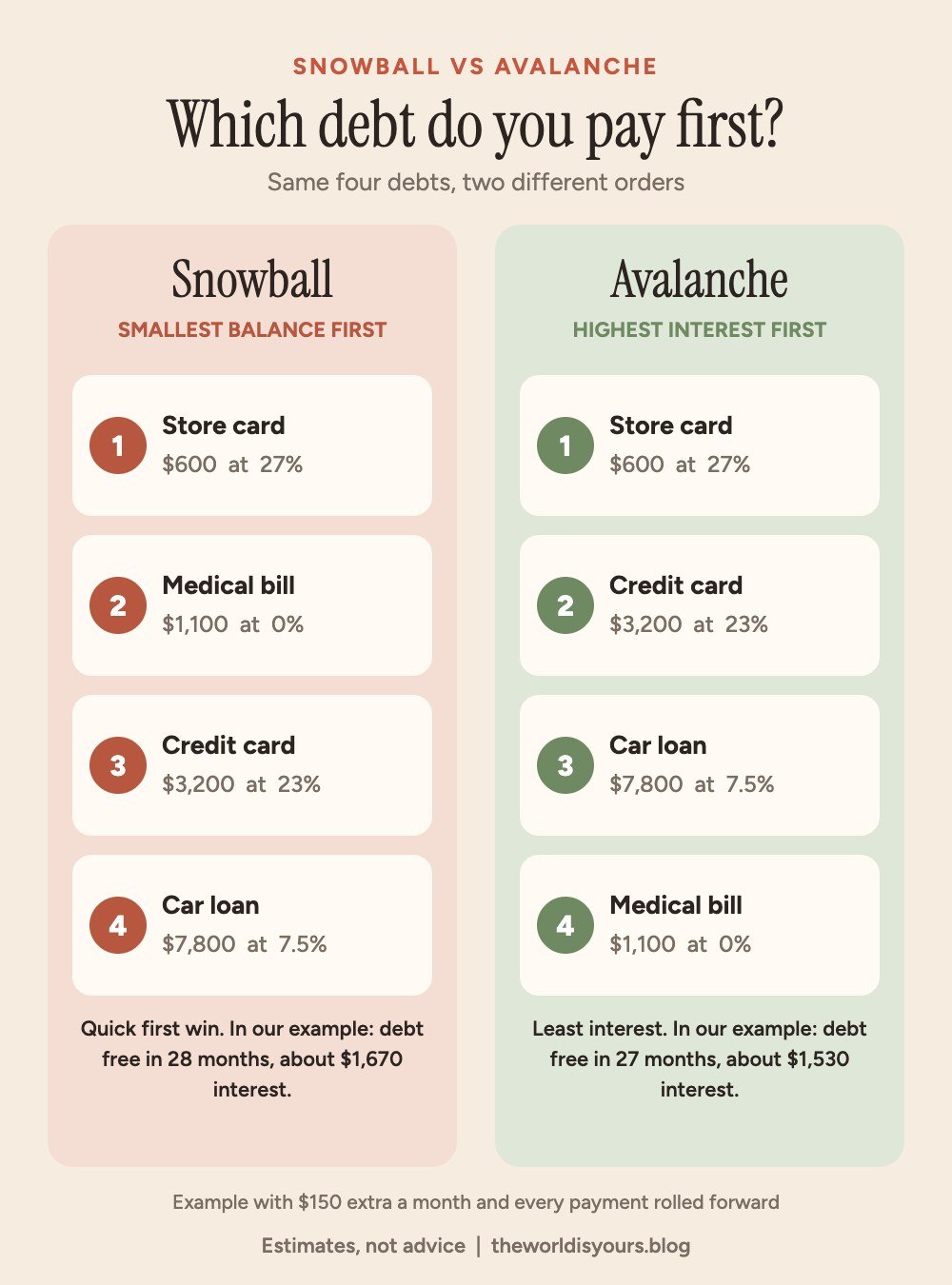
The avalanche saves the most money, because the most expensive debt goes first. The snowball often keeps people going longer, because the first debt disappears fast and that win feels great.
| Debt snowball | Debt avalanche | |
|---|---|---|
| Pay first | Smallest balance | Highest interest rate |
| Best for | Staying motivated, lots of small debts | Saving the most on interest, high-rate cards |
| First win | Fast, often within a few months | Can take longer if the high-rate debt is big |
| Interest paid | A bit more | The least |
| Biggest risk | Paying more interest than you need to | Losing steam before the first payoff |
How the debt snowball works
Line your debts up from smallest balance to largest, ignoring the interest rate. Pay minimums on everything, put all your extra on the smallest one, and when it’s gone, add its payment to the next smallest.
The payment grows like a snowball rolling downhill. It’s the method Dave Ramsey made famous, and it works because quick wins keep you going.
How the debt avalanche works
Line your debts up from the highest interest rate to the lowest. Same rules: minimums on everything, extra on the top one, then roll the payment down the list.
Mathematically it’s the cheapest way to get out of debt. If you’re a numbers person and your highest-rate debt isn’t huge, start here.
How to pick (or mix them)
- If you’ve tried before and given up, pick the snowball. A quick win matters more than a small interest saving.
- If you have one big credit card at a high rate, pick the avalanche. Every month it sits there costs you the most.
- If two debts are close in size, pay the higher-rate one first. That mix gives you most of the savings and most of the motivation.
- Whichever you pick, the most important part is the same: never let the payment shrink when a debt is paid off. Roll it into the next one.
A real example: $12,700 across four debts
Here’s an honest example, worked out month by month with interest. Your numbers will be different, so try your own in the calculator below.
| Debt | Balance | Interest | Minimum |
|---|---|---|---|
| Store card | $600 | 27% | $25 |
| Credit card | $3,200 | 23% | $96 |
| Medical bill (payment plan) | $1,100 | 0% | $50 |
| Car loan | $7,800 | 7.5% | $210 |
| Total | $12,700 | $381 a month |
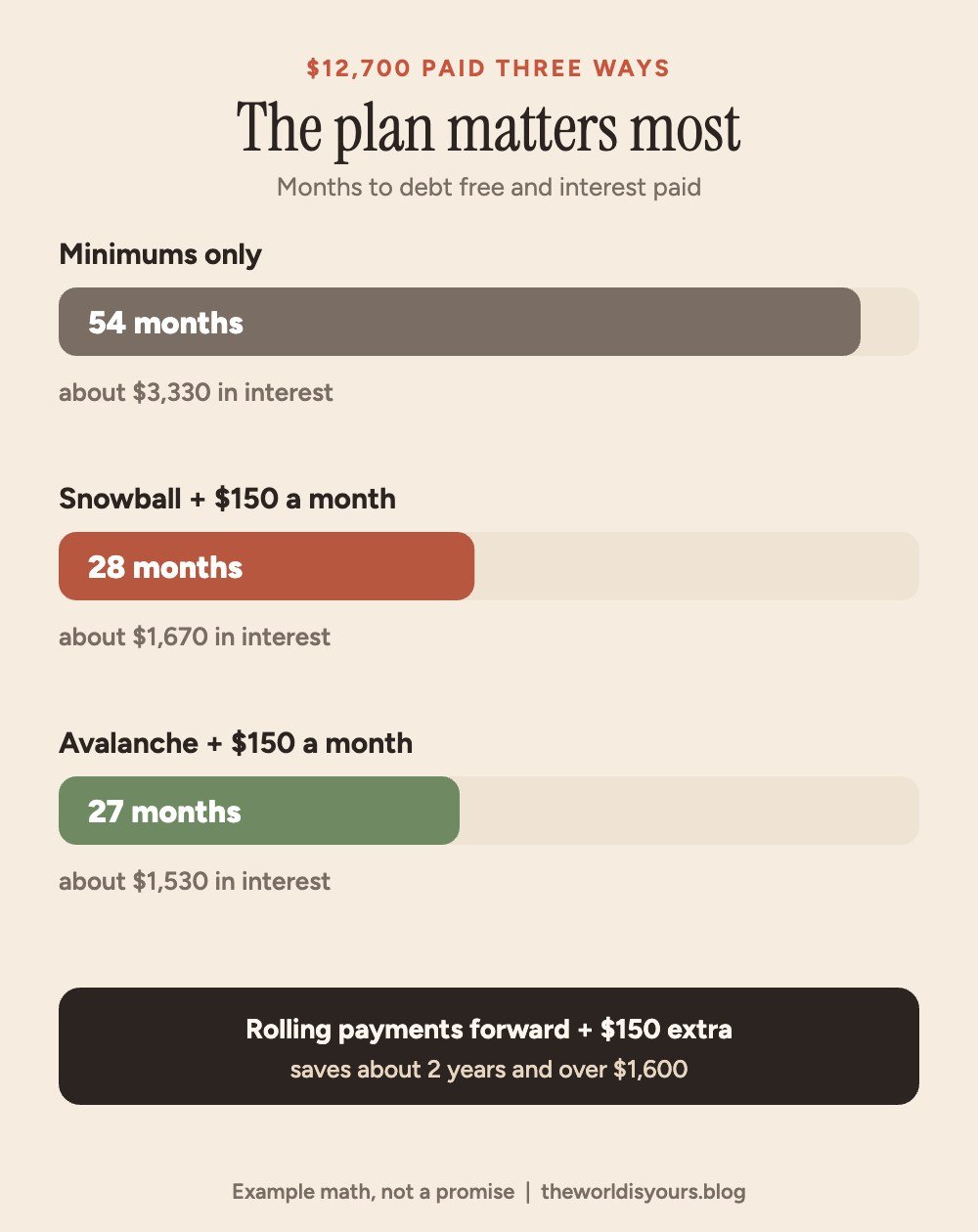
| Plan | Debt free in | Interest paid |
|---|---|---|
| Minimums only, nothing rolled over | 54 months (4.5 years) | about $3,330 |
| Snowball, plus $150 extra a month | 28 months | about $1,670 |
| Avalanche, plus $150 extra a month | 27 months | about $1,530 |
Two things jump out. The method matters a little: the avalanche saves about $140 here. The plan matters a lot: rolling payments forward and adding $150 a month saves around two years and over $1,600.
Debt payoff calculator
Change the example numbers to your own. It works out the month each debt could be gone and the interest you’d pay with each method.
Debt payoff calculator: snowball vs avalanche
Put in up to four debts (or keep the example numbers), choose your extra payment, and see when each debt could be gone and how much interest you would pay with each method.
Debt free in about
These are estimates from the numbers you enter, with interest worked out monthly and rates that stay the same. Real balances change with new charges, fees and rate changes. General information, not financial advice, and I’m not a financial advisor.
How to pay off credit card debt faster
Credit cards are usually the most expensive debt in a family budget, with rates often at 20% or more. A few things help most:
- Stop adding to it. Take the cards out of your wallet and phone. Pay with debit or cash while you pay them down.
- Pay more than the minimum. Minimums are set so the balance takes years to clear. Even $20 extra helps.
- Ask for a lower rate. Call, mention your on-time payments, and ask what they can do.
- Look at a balance transfer carefully. A 0% offer can help if you can clear it before the offer ends. Most charge a transfer fee (often 3% to 5%), and the rate jumps after, so do the math first.
- Pay twice a month. Splitting your payment can trim a little interest and makes it feel more manageable.

Where to find extra money for your debt payments
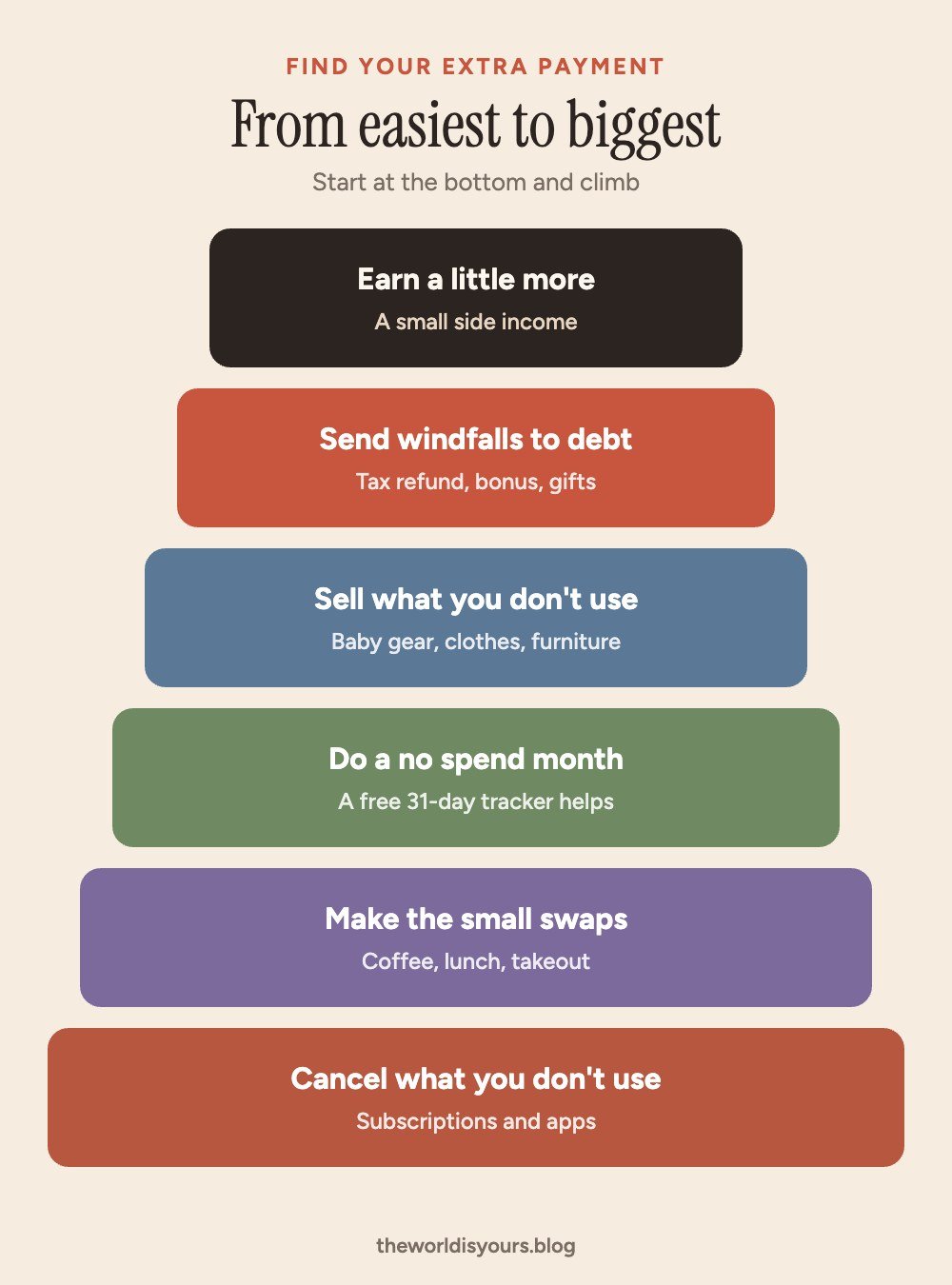
- Cancel what you don’t use. Check your statements for subscriptions and apps. Many families find $20 to $60 a month.
- Do a no spend month. The no spend challenge has a free 31-day tracker.
- Use a money saving challenge in reverse. Instead of saving each week’s amount, pay it to your target debt. The money saving challenge charts work well for this.
- Sell what you no longer need. Kids’ clothes, baby gear, furniture and gadgets.
- Send windfalls straight to debt. A tax refund, a bonus or birthday money. Even half of it makes a dent.
- Earn a little more. A small side income of a few hundred dollars a month can shorten a plan by years. See side hustles for moms and side hustle ideas at home.


Give found money a home


How to pay off debt on a low income
If money is tight, the plan is the same, the steps are just smaller. Please don’t feel behind because your extra payment is $10. It still counts.
- Protect the basics first: housing, utilities, food and transportation to work come before any credit card.
- Call before you fall behind. Many lenders have hardship plans with lower payments or rates for a while.
- Talk to a nonprofit credit counselor. Look for one through the National Foundation for Credit Counseling (NFCC). A first session is often free or low cost, and they can tell you if a debt management plan makes sense.
- Check what help you qualify for. Calling 211 in the US connects you to local help with bills, food and utilities, which can free up money for debt.
- Start a tiny challenge. The low income savings challenge ideas work for debt too: $1 to $5 at a time.
Paying off debt as a busy mom
You don’t need hours. You need one sitting to set it up and 20 minutes a month after that. Do the setup after bedtime with a cup of tea and the tracker.
- Put the extra payment on the same day as payday, so it goes before the money gets spent.
- Tell your partner the plan and the debt-free date. It’s much easier when you’re both pulling the same way.
- Make it visible for the kids too, without the stress: a jar or a chart they can color in teaches them more about money than any lecture.
- Plan for the big months (Christmas, back to school, birthdays) with a small sinking fund, so they don’t go on a card.
Debt relief scams and red flags
When you’re stressed about debt, quick fixes are tempting. The FTC warns about debt relief companies that promise to make debt disappear and charge big fees first.
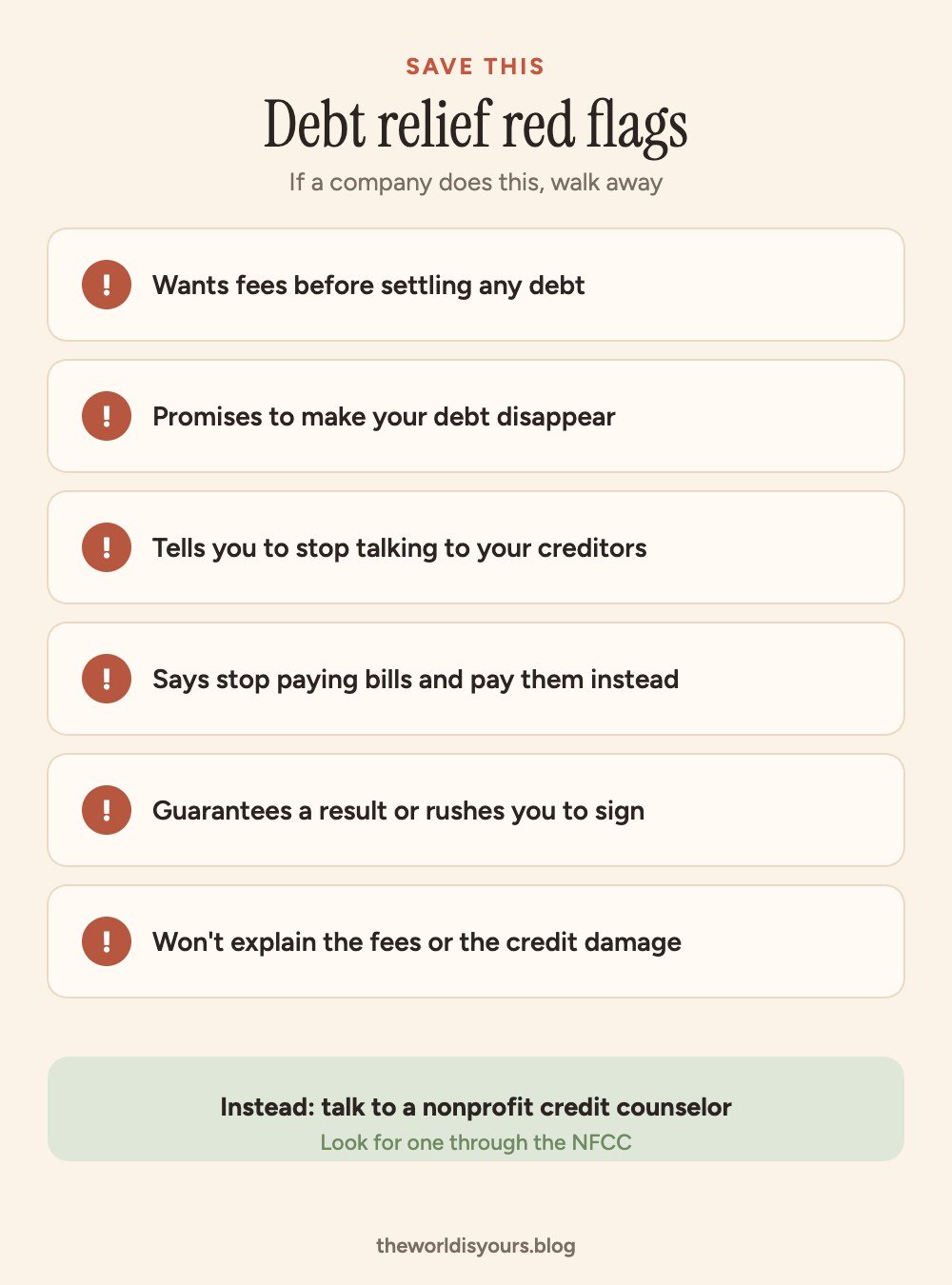
- They want fees before they’ve settled or reduced any of your debts.
- They promise to make your debt go away or stop collectors and lawsuits.
- They tell you to stop talking to your creditors.
- They push you to stop paying your bills and send money to them instead, without explaining the damage to your credit and the extra fees.
- They guarantee a result or rush you to sign today.
How to stay motivated until you’re debt free
Debt payoff is mostly a patience game. The middle months are the hardest, when the first win has faded and the end feels far away.

- Celebrate every payoff with something free or small: a favorite dinner at home, a walk somewhere pretty, an early night.
- Write your why at the top of the plan: a family trip, a calmer Christmas, sleeping better.
- Look at how far you’ve come, not just how far is left. Your log does that for you.
- If you slip and use a card, don’t quit. Add it to the list, adjust the date, carry on.

Books that keep you going


Common debt payoff mistakes
| Mistake | Do this instead |
|---|---|
| Spreading extra money across every debt | Put all the extra on one target at a time |
| Letting the payment shrink after a payoff | Roll the old payment into the next debt |
| No emergency cushion | Keep a small starter fund so surprises don’t go on a card |
| Still using the cards | Pause the cards while you pay them down |
| Paying a debt relief company up front | Talk to a nonprofit credit counselor first |
| Not tracking | Color in the chart and update the log monthly |
Debt payoff plan FAQ
What is the best debt payoff plan?
The best plan is the one you’ll stick with. The avalanche (highest interest first) saves the most money, and the snowball (smallest balance first) gives quick wins that keep many people going. Both work as long as you pay every minimum and roll each finished payment into the next debt.
How do I start paying off debt with no money?
Start by listing every debt and paying the minimums so nothing goes late. Then look for small amounts: a canceled subscription, a no spend week, selling one thing you don’t use. Even $10 to $25 extra a month starts the snowball, and a nonprofit credit counselor can help if minimums are already too much.
Is the debt snowball or avalanche faster?
With the same extra payment, the avalanche is usually a little faster and cheaper because the highest-rate debt goes first. In our example the difference was about one month and $140. The snowball can still be the better choice if quick wins help you keep going.
Should I save or pay off debt first?
Most people do both in a small way: build a starter emergency cushion (something like $500 to $1,000) first, then put extra money toward debt. Without a cushion, the next surprise bill tends to go back on a credit card.
Does paying off debt improve my credit score?
Paying on time and lowering your credit card balances usually helps your score over time, because payment history and how much of your credit you’re using matter a lot. Closing old cards right after paying them off can sometimes lower it, so think before you close them.
How long does it take to pay off debt?
It depends on how much you owe, the interest rates and how much extra you can pay. Use the calculator above with your own numbers. In our example, $12,700 took 54 months on minimums alone and about 27 to 28 months with $150 extra a month.
Your next step
Tonight, print the tracker and fill in page one. That one list is the hardest part, and once it’s done you’ll know exactly where you stand.
Then pair it with the free budget planner to find your extra payment, and a no spend month to give your plan a strong start. You’ve got this.